Abortion
Abortion, Generally
Mike Rogers Said He Supported “The Further Restriction Of Abortion” Of Any Abortion “Not Related To Saving The Life Of The Mother.” According to the Lansing State Journal, “In recent years, the Michigan Legislature has placed limits on abortion – including a 24-hour waiting period and requiring minors to receive parental permission. What restrictions, if any, do you support on abortion? […] Mike Rogers R-Howell 546-9712 ‘I support the further restriction of abortion based on the sex of the baby, and of any abortion not related to saving the life of the mother.’” [Lansing State Journal, 7/25/94]
Mike Rogers Was Opposed To Abortion. According to the Lansing State Journal, “They sound alike as they call for: -Tougher sentencing for violent criminals, and more austere prison conditions. -Ending lifestyle instruction in schools, more stress on reading, writing and arithmetic. -Opposition to abortion, gun control and assisted suicide While Rogers lauds Republican Gov. John Engler’s lead in dropping general assistance, Dragonetti credits Engler for leading the voters to shift much school finance from property levies to a sales-tax share.” [Lansing State Journal, 7/26/94]
Mike Rogers Said He Would Fight Against Pro-Choice Proponents. According to the Livingston County Daily Press and Argus, “One issue on which Rogers agrees with Dillingham is abortion. ‘I commend him for championing the cause,’ Rogers said. Rogers said he would continue the fight against pro-choice and assisted suicide proponents.” [Livingston County Daily Press and Argus, 7/27/94]
Mike Rogers: “I Support All Restrictions On Abortion.” According to the Lansing State Journal, “In recent years, the Michigan Legislature has placed limits on abortion – including a 24-hour waiting period and requiring minors to receive parental permission. What restrictions, if any, do you support on abortion? […] Mike Rogers R-Howell 1-546-9712 ‘I support all restrictions on abortion, since I consider it intentional taking of life. I would further support legislation restricting abortions done for choosing the sex of a baby.’” [Lansing State Journal, 10/24/94]
Mike Rogers Repeatedly Said The Federal Government Was Established For Unborn Lives And Called Roe v. Wade A “Travesty.” [Mike Rogers Constituent Letter, accessed via Oakland University Archives, 2004]
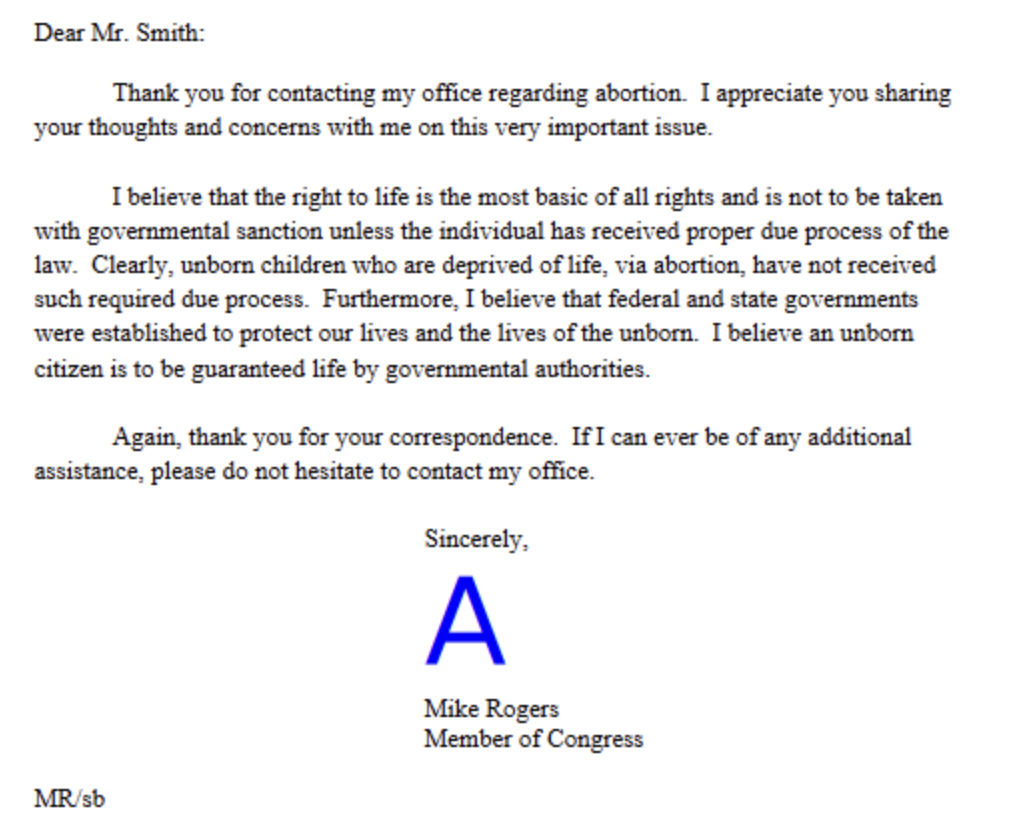
Mike Rogers Said That The Federal Government Was “Established To Protect Our Lives And The Lives Of The Unborn.” [Mike Rogers Letter To Constituent, accessed via Oakland University Archives, 12/17/96]
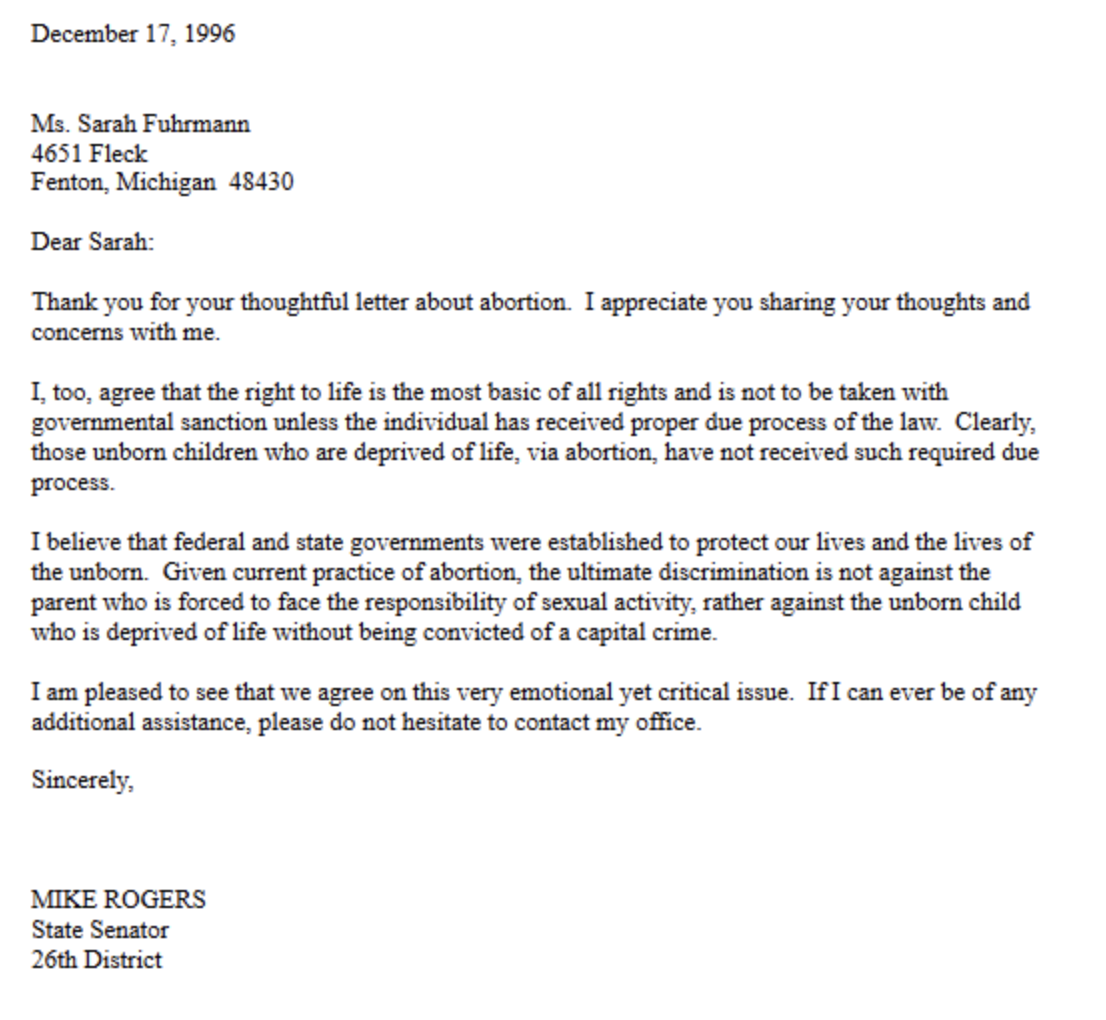
Mike Rogers Called For Legislation On “Capitol Hill” On Abortion And Called Roe v. Wade A “Travesty.” [Mike Rogers Letter To March For Life, accessed via Oakland University Archives, 1/22/00]
Mike Rogers Opposed Abortion Except To Save The Life Of The Mother. According to Congressional Quarterly, “On abortion, the candidates are, in Rogers' words, ‘as far apart as we can get.’ Rogers opposes abortion except to save the life of the pregnant woman; Byrum supports abortion rights and voted in the legislature against banning a particular technique labeled by its critics as ‘partial-birth’ abortion. Byrum was one of the first candidates for 2000 endorsed by EMILY's List, the organization that backs Democratic women who support abortion rights.” [Congressional Quarterly, 1/13/00]
[VIDEO] Mike Rogers Said That He Was A “Pro-Life Candidate My Entire Career.” “Hi. Can you please tell me your position on abortion? Rogers: Yes. So I’ve been a pro-life candidate my entire career. The Supreme Court did something interesting. They pushed it down to the states. And so I look at this. I mean, this is the most intense personal decision anybody would make in their life. It happens to be their family and their faith. And my argument, the states are the best place to handle those conversations. I think the states are going to mediate this. I know New Hampshire has a 24 week requirement. Other states have other requirements. I think as a pro-lifer myself and in the pro-life community, we're going to have to find ways to educate. I think we lost the education debate on this about where states should be. And I think that's probably the best way to handle it. And this this is an issue, again, because it's so personal, because it's such a faith-based and family based decision, better handle it locally where you can have conversations with people are going to make that decision. Thank you.” [WMUR, 5/5/23]
[VIDEO] Mike Rogers Said He Did Not Know If He Would Support A Federal Ban On Abortion. “Quick follow up for you here, congressman, coming from me on this. If you are in the White House and Congress does decide to pass some kind of law, if you think it’s a states issue, does that mean it’s an automatic veto for you, even though you’re pro-life? Mike Rogers: I’d have to look at it. I believe that the least amount that the federal government does, the better off we’re all going to be. I mean, remember when federal government got involved in education, they said they were going to cure the problem. We have the federal Department of Education, and look where our education is today. So I would be inclined to say if it’s a states issue, it needs to be a states issue. It doesn't mean you can't advocate for your position. It doesn't mean you shouldn't be having conversations about your position. But I don't know if a federal ban superseding states which the Supreme Court said that's where it ought to be. I'm just I’m not sure. I don't think I’d be there. Okay.” [WMUR, 5/5/23]
Rogers Aligned With Trump’s Position For Abortion Regulations To Be Left To States Despite Previous Support For Federal Abortion Restrictions. According to USA Today, “Republicans facing tough reelection campaigns this fall are welcoming former President Donald Trump's newly announced position that abortion regulations should be left up to the states, even as some of their less vulnerable peers openly contradict him. […] Republican Senate candidates Mike Rogers of Michigan, Bernie Moreno of Ohio and David McCormick of Pennsylvania also reportedly staked out similar positions, though both Moreno and Rogers have previously indicated support for some federal restrictions.” [USA Today, 4/10/24]
Rogers Agreed That All Voters Supported Abortion Access To Some Extent And He Wanted The Decision To Return To States. “Host: Apparently, voters of all walks of life seem to support abortion access to some act to some extent. Right. 1:30 Mike Rogers - I think that's very, very true. And so when you look at, you know, listen, I'm a pro-life legislator. I did believe it should go back to the states. I've said that for years.” [Mike Rogers, The Steve Gruber Show, Michigan, 4/12/24]
Anti-Abortion Stance
Rogers Opposed Abortion Access
Rogers Opposed Abortion Rights. According to Detroit Free Press, “On the other hand, Rogers of Brighton opposes abortion rights and Byrum of Onondaga favors them, although the issue was not a high-profile one.” [Detroit Free Press, 11/8/00]
Anti-Choice Groups Supported Rogers
Right To Life Of Michigan Endorsed Rogers Congressional Bid. According to Detroit News, “Endorsements: National Federation of Independent Businesses; Michigan Farm Bureau; Michigan Chamber of Commerce; Fraternal Order of Police; Police Officers Association of Michigan; National VFW; Michigan Association of Realtors; Right to Life of Michigan.” [Detroit News, 10/30/00]
Rogers Received Support From Anti-Choice Groups. According to the Associated Press, “Rogers, of Howell, got support from business and other conservative interests, including gun rights and anti-abortion groups.” [Associated Press, 11/7/00]
Rogers Repeatedly Backed National Abortion Bans
Rogers Repeatedly Backed National Abortion Bans. According to American Independent, “Former U.S. Rep. Mike Rogers joined the race on Sept. 6. While his campaign site does not include an issues page, over 14 years in the House, he repeatedly backed national abortion bans and routinely earned 0% ratings from Reproductive Freedom for All.” [American Independent, 9/25/23]
Rogers Claimed To Agree With Trump That Abortion Should Be Decided At The State Level
Rogers Said Abortion Should Be Decided At The State Level Despite Co-Sponsoring A Fetal Personhood Bill In 2013. According to the New York Times, ‘“I agree with President Trump that the issue of abortion should be decided at the state level,’ Mike Rogers, a former longtime House member from Michigan whom Mr. Trump endorsed in that state’s open-seat Senate race, said in a statement. As a House member in 2013, Mr. Rogers was one of 131 Republican co-sponsors of the Life at Conception Act, a fetal personhood bill that did not pass.” [New York Times, 4/9/24]
Rogers Doubled Down On His Support For States To Have Jurisdiction Over Abortion Legislation
[VIDEO] Rogers Doubled Down On His Support For States To Have Jurisdiction Over Abortion Legislation. “So Michigan has already made this decision. They've made abortion legal. I actually supported Roe versus Wade coming back to the states. It's a hard, tough, emotional decision for every woman who has to even deal with this decision. My argument is that's why I wanted it back in the States. You’re closest to your doctor, you’re closest to your state legislator. Michigan has spoken on this. It's kind of done for us. It's legal in the state of Michigan. I'm not going to go back to Washington, D.C., and change that. That would not be appropriate, I don't think. And so now it gives us the opportunity to talk about all the other issues that impact women.” [WWJ-DET (CBS), 3/15/24] 240315_SAG_5775_A
Rogers Lobbied For A National Abortion Ban
Rogers Lobbied For A National Abortion Ban. According to Public Now, “Rogers spent his time in Congress ‘lobbying for a national abortion ban’ and co-sponsored and voted for numerous bills that would have banned abortion. In Congress, Rogers co-sponsored four bills ‘attempting to define human life as beginning at the moment of fertilization’ which would jeopardize access to IVF and contraception, including IUDs and Plan B.” [Public Now, 3/18/24]
Rogers Aligned With Trump’s Position For Abortion Regulations To Be Left To States Despite Previous Support For Federal Abortion Restrictions
Rogers Aligned With Trump’s Position For Abortion Regulations To Be Left To States Despite Previous Support For Federal Abortion Restrictions. According to USA Today, “Republicans facing tough reelection campaigns this fall are welcoming former President Donald Trump's newly announced position that abortion regulations should be left up to the states, even as some of their less vulnerable peers openly contradict him. […] Republican Senate candidates Mike Rogers of Michigan, Bernie Moreno of Ohio and David McCormick of Pennsylvania also reportedly staked out similar positions, though both Moreno and Rogers have previously indicated support for some federal restrictions.” [USA Today, 4/10/24]
Rogers Stated Trump Description Of His Destruction Of Roe V. Wade Was "Elegant”
[AUDIO] Rogers Stated Trump Description Of His Destruction Of Roe V. Wade Was "Elegant." “And his belief, and certainly mine is that you don't go you don't send people back to Washington, D.C. to undo what the state has done is a part of their constitution. And so he was talking about other ways that you could, you know, support being a pro-life, but legally taking it back to Washington, D.C. is not the right answer. We sold it here. The other states are going to get there. I think he I thought it was a pretty elegant answer about, hey, states are coming to their own. This is where your doctor is. This is where your family is. This is where your clergy is here in the state of Michigan. That's where these decisions. And, you know, it's it's a horrible thing for a woman to even have to go through this. But this is where they should be made. They shouldn't be made in Washington, D.C. That's what created all the trouble for the last, whatever, 50 years. And so I think this was I thought he handled it actually pretty well. And he said the states need to do this.” [Mike Rogers, All Talk with Jordan and Dietz, Michigan, 5/2/24; 240502_TTA_1233_A
Rogers Stated He Would Not Vote In Favor Of A National Abortion Ban If It Came Up During His Time In Senate
Rogers Stated He Would Not Vote In Favor Of A National Abortion Ban If It Came Up During His Time In Senate. According to KSN, “Rogers dismisses the idea that abortion rights are still on the ballot in Michigan. He said he would not vote in favor of a national abortion ban if it came up during his time in the Senate, although he did vote in favor of a 20-week abortion ban while serving in the House. ‘I’m a states’ rights guy. I’m not going back to Washington, D.C., to undo what the people of Michigan decided to do,’ said Rogers. Republicans welcome Rogers as a moderate, sensible voice who has a legitimate chance to seize the unexpected opportunity that arose with Stabenow’s retirement, in a state where they haven’t been winning much lately. Democrats, meanwhile, think Slotkin could emerge as a leading voice of the next generation of party leaders.” [KSN, 5/2/24]
Rogers Stated He Would Not “Undo” The Michigan Law On Abortion Regulations
Rogers Stated He Would Not “Undo” The Michigan Law On Abortion Regulations. According to Bridge Michigan, “Abortion advocates won big at the Michigan ballot box two years ago with passage of Proposal 3, which wrote abortion rights and reproductive health access into the state constitution. Democrats, too, saw success at the polls, winning a sweep of statewide offices and majority control of the Legislature. While leading Republican U.S. Senate candidate Mike Rogers has said he won’t try to ‘undo’ the Michigan law, abortion rights groups on Thursday urged voters to avoid complacency, pointing to the possibility of a federal abortion ban.” [Bridge Michigan, 6/20/24]
Rogers Was Slammed In An Ad By Elissa Slotkin For His Anit-Abortion Record
Rogers Was Slammed In An Ad By Elissa Slotkin For His Anit-Abortion Record. According to Detroit News, “Democrat Elissa Slotkin's campaign for U.S. Senate in Michigan dropped two TV ads Wednesday morning attacking her Republican opponent Mike Rogers on his anti-abortion record, marking the first time she's deployed the issue on the air in the general election. […] 'All of our options were terrible, but Mike Rogers thinks it's okay for politicians to make those medical decisions that saved my life,' Sarah says. 'Rogers even supported a nationwide ban on abortion. I'm scared that Mike Rogers will continue to take away my rights.'” [Detroit News, 9/11/24]
- Rogers Indicated He Supported A Constitutional Amendment To “Protect The Right Of Unborn Children.” According to Detroit News, "The ad references a 2000 questionnaire by the Michigan Catholic Conference in which Rogers, as a candidate for Congress, indicated that he supported a constitutional amendment 'to protect the right of unborn children.' The questionnaire was part of Rogers' congressional papers archived by Oakland University, according to Jezebel. In the same questionnaire, Rogers wrote that he opposes abortion "at any time except to save the life of the mother." [Detroit News, 9/11/24]
- Rogers Supported “All Restrictions On Abortion.” According to Detroit News, "Slotkin's other ad targeting Rogers on Wednesday more broadly highlights his record and cites a 1994 Lansing State Journal article in which the former congressman said he supports "all restrictions on abortion." Rogers won a race for a seat in the Michigan Senate that year." [Detroit News, 9/11/24]
Rogers Shifted His Support On Federal Abortion Restrictions That Were Inconsistent. According to Detroit News, “While Rogers had an anti-abortion record during his seven terms in Congress, he has since shifted his position, saying after he launched his Senate campaign last year that he wouldn't support federal restrictions in Congress that are ‘inconsistent’ with Michigan's 2022 constitutional amendment broadly protecting access to the procedure. ‘This is one of the most difficult decisions a woman will have to make in her life — a position that many never imagined they’d even find themselves in. I strongly believe those decisions should be made solely by her, her family, her doctor and her God,’ Rogers said in a statement Wednesday in response to the ads. ‘I’ve been perfectly clear: Michigan came to a consensus, and I will respect the will of the voters, as I have always done. This is simply a continuation of the congresswoman’s inability to tell the truth.’” [Detroit News, 9/11/24]
Rogers Responded To Critics About His Anti-Abortion Record By Stating He Would Not Change Decisions Already Made By Michigan Voters
Rogers Responded To Critics About His Anti-Abortion Record By Stating He Would Not Change Decisions Already Made By Michigan Voters. According to Mike Rogers' Youtube, “I'm Mike Rogers. I know that a decision about a pregnancy is one of the most difficult and personal decisions a woman will make. Michigan voters have already decided the issue and I respect that decision in the Senate. I won't do anything to change it.” [Youtube, Mike Rogers for Senate - “THE TRUTH”, 9/11/24]
Rogers Stated He Would Let Michigan Voters Keep Proposal 3, Which Enshrined The Right To Reproductive Freedom Into Law. According to Fox News, “The Republican Senate candidate in Michigan, former Rep. Mike Rogers, addressed what promises to be a top concern of many voters in November in a new campaign ad, making his position clear. ‘I know that a decision about a pregnancy is one of the most difficult and personal decisions a woman will make,’ Rogers said in a new ad, appearing seated alongside his wife, Kristi Rogers, who held his hand. ‘Michigan voters have already decided the issue, and I respect that decision,’ he explained, referencing the 2022 election, in which Michigan voters chose to enact Proposal 3, an abortion rights amendment that enshrined the ‘fundamental right to reproductive freedom’ into law.” [Fox News, 9/11/24]
Michigan Prop 3
Mike Rogers Did Not VOte On Prop 3 Because He Lived In Florida, But Said He Would Have Voted Against It
[VIDEO] Mike Rogers Said He Did Not Vote On Prop 3 Because He Lived In Florida, But That He Was A “Pro-Life Guy.” “Skubick: How did you vote on Prop 3? Rogers: Prop 3? Skubick: The abortion issue. Rogers: Ah, um. Listen, I think – here’s what’s going to happen on abortion in America. Skubick: How did you vote on it? Rogers: You know, there’s a curtain behind there for a reason. Oh come on, that’s funny. Melinn: I’m just curious if you even voted though in Michigan? Rogers: I did not vote in Michigan. I had moved to Florida because of some business opportunities I had down there. Here’s what I think is going to happen on abortion in America. Every state capitol is going to go through this fight where it belongs. And if you look at where the average American is, listen, I’m a pro-life guy. I voted pro-life. And I don’t walk away from that. I think that what’s going to happen is everyone’s going to determine by each state what length of time you have to make your decision before you can’t do it. If you look at polling numbers, the third-trimester, Americans find unacceptable. Now you’ll find a lot of places in the county where they sold it as one thing and did another thing. But I think what you’re going to find over time is that number is going to settle in where people have a comfort level of allowing women to have time to decide what they want to do.” [Off The Record Overtime, 3/3/23]
[VIDEO] Mike Rogers Said If He Had Been In Michigan, He Would Have Voted Against Prop 3. “Skubick: If you had been here in Michigan, would you have supported Proposal 3? Rogers: I don’t believe, I’m not sure how it was written honestly. Skubuck: It was written basically to say a woman has a right to choose. And it legalized abortion. Rogers: Yeah, I probably wouldn’t have done it because it covers right up to the day of birth. And I’m not there. I don’t think most Americans are there. I think that’s kind of an extreme position candidly. I think what’s going to happen is they’re going to settle on a time in the future. I’ll put money on that.” [Off The Record Overtime, 3/3/23]
[VIDEO] Mike Rogers Would Not Say If A Woman Has A Right To Choose. “Skubick: So you would be pro-choice with a timeframe? Rogers: No. No. I’m going to continue to be pro-life. What I think the pro-life community has to do – Skubick: Does a woman have a right to choose? Rogers: According to Michigan, Montana, Kansas, yes, yes, yes. So a matter of fact, it is not illegal anywhere and wasn’t illegal under Roe v. Wade. What the pro-life community in my mind needs to focus on is the alternatives and talking people into ways that they don’t have to have an abortion. I think that’s what’s going to happen.” [Off The Record Overtime, 3/3/23]
Medicaid
1996: Mike Rogers Voted For Legislation To Clarify The State Ban On Medicaid Funds Being Used For Abortions
1996: Mike Rogers Voted For Legislation Clarifying That State Law Prohibits Medicaid Funds From Going Towards Abortions And Prohibiting Accepting Reimbursements For Performing An Abortion. In February 1996, Mike Rogers voted for House Bill 5458. The legislation would, according to the Associated Press, clarify “that state law prohibits the diversion of Medicaid funds to perform abortions, and prohibits a health care professional or a health facility from accepting reimbursement from public funds for performing an abortion. Under the new law, violators will be liable for a civil fine of up to $10,000.” The legislation passed the Michigan Senate on a 28-9 vote. The legislation then passed the Michigan House on a 76-27 vote. The legislation was signed by Governor John Engler and became law. [Michigan Legislature, House Bill 5458, 2/26/98; Associated Press, 3/14/96]
- Legislation Would Clarify That State Law Prohibits The Diversion Of Medicaid Funds To Perform Elective Abortions, And Prohibits A Health Care Professional Or A Health Facility From Accepting Reimbursement From Public Funds For Performing An Abortion. According to the Detroit Free Press, “According to McManus and backers of the bill, primary care physicians knowingly refer pregnant women for abortions under the guise of obtaining family planning services. HMOs then submit bills for family planning services while performing abortions and charging Medicaid recipients only $50, McManus said. The HMOs have been warned by the state that such a practice would conflict with the intent of state law. The bill would clarify that state law prohibits the diversion of Medicaid funds to perform elective abortions, and prohibits a health care professional or a health facility from accepting reimbursement from public funds for performing an abortion. ‘I do not believe Michigan taxpayers voted in 1988 for a $50 co-pay on Medicaid abortions,’ McManus said late last year when the bill passed the House. ‘Family planning services cannot be used as a shield to circumvent state law.’ A violation of the proposed law would carry a civil fine of up to $10,000.” [Detroit Free Press, 2/19/96]
- Mike Rogers Co-Sponsored The Senate Version Of The Legislation. [Michigan Legislature, Senate Bill 0793, 12/6/95]
Partial-Birth Abortion
1996: Mike Rogers Voted For Legislation To Ban So-Called Partial Birth Abortion
1996: Mike Rogers Voted For Legislation To Ban So-Called Partial-Birth Abortion. In May 1996, Mike Rogers voted for House Bill 5889. The legislation would, according to the Detroit Free Press, “strip the licenses of doctors who perform so-called partial-birth abortions.” The legislation passed the Michigan House on a 63-36 vote. The legislation then passed the Michigan Senate on a 28-8 vote. The legislation was signed by Governor John Engler and became law. [Michigan Legislature, House Bill 5889, 5/29/96; Detroit Free Press, 5/16/96]
- Legislation Would Strip The Licenses Of Doctors Who Perform So-Called Partial-Birth Abortions. According to the Detroit Free Press, “Michigan's powerful antiabortion lobby will unite today at the Capitol around a legislative initiative that would strip the licenses of doctors who perform so-called partial-birth abortions. Enactment of the measure, which has the support of Gov. John Engler and leaders in the House and Senate, would mark the first restriction on abortion procedures in Michigan since the 1973 U.S. Supreme Court decision in Roe vs. Wade affirmed the constitutional right to an abortion. Federal legislation to criminalize the procedure was passed by Congress and vetoed by President Bill Clinton last month. Rep. James Ryan, R-Redford Township, one of the bill's sponsors, said Wednesday that backers hope to pass the legislation by early summer. Partial-birth abortion is a rare procedure performed late in a pregnancy in which a fetus is drawn into the birth canal, its skull penetrated and brains removed. Ryan called the procedure ‘brutal and reprehensible.’” [Detroit Free Press, 5/16/96]
- Legislation Only Provided An Exception For Life Of The Mother. According to the Associated Press, “The rare procedure attracted increased interest when President Clinton vetoed a federal bill to ban it. Gov. John Engler endorsed a state bill to ban it, and the issue has taken on potential importance for the presidential race. The bills would prohibit partial-birth abortions except when the mother's life was in danger. The term refers to a technique where the fetus is extracted feet first and the doctor contracts its skull, by sucking out its brain, so it will fit through the birth canal.” [Associated Press, 5/29/96]
- Mike Rogers Co-Sponsored The Senate Version Of The Legislation. [Michigan Legislature, Senate Bill 1029, 5/15/96]
Legislation Was Written So Broadly It Could Forbid Nearly All Abortions
Legislation Was Written So Broadly That It Could Forbid Nearly All Abortions. According to the Associated Press, “Legislation to ban most so-called ‘partial-birth abortions’ in Michigan passed a House panel on Thursday, but a doctor said the bill is so broad it could forbid nearly all abortions. ‘The way it is worded could outlaw 95 percent of all abortions,’ said Dr. Mark Evans, vice chairman of the obstetrics and gynecology department at Wayne State University's medical school. Evans was referring to the bill's definition of partial-birth abortion, which does not describe in detail a rare procedure that involves extracting the fetus feet first and contracting its skull so it will fit through the birth canal. Instead, the legislation describes partial-birth abortions as one in which the doctor ‘partially vaginally delivers a living fetus before killing the fetus and completing the delivery.’ That, Evans said, could apply to almost any abortion, including those performed early in a woman's pregnancy in which suction is used to extract the fetus from the womb. Only abortions to remove a stillborn fetus would be clearly exempt, he said.” [Associated Press, 5/24/96]
Opponents Said The Legislation Was A Thinly Veiled Attempt To Ban Nearly All Abortions. According to the Associated Press, “Rep. Jim Ryan, R-Redford Township responded: ‘Just because it's not happening in Michigan does not mean it (the ban) is not appropriate.’ Opponents said the bill, instead of being needed, was actually a thinly veiled attempt to ban nearly all abortions. They pointed out the bill's definition of the procedure is so vaguely worded it could apply to nearly any abortion, including those performed very early in a woman's pregnancy.” [Associated Press, 5/30/96]
Mike Rogers Voted Against An Amendment That Still Banned The Procedure But Narrowed The Bill’s Scope
Mike Rogers Voted Against An Amendment That Would Have Banned Partial-Birth Abortion But Defined The Technique In Proper Medical Terms, Narrowing The Bill’s Scope. According to the Associated Press, “But Sen. Gary Peters, D-Pontiac, charged the legislation ‘has a lot more to do with politics than with public policy.’ ‘The language is much too broad and too vague,’ he said, warning that it might outlaw 95 percent of all abortions. That, he said, is the intention of backers of the bill. Senate Minority Leader John Cherry, D-Clio, charged Wednesday that Republicans were using partial-birth abortion as a ‘wedge issue’ to try to score political points with the voters. ‘It's obvious they're putting people on record,’ he said of GOP lawmakers. The Senate rejected, 20-13, Peters' alternative bill, which he said would also ban the procedure but define the technique in proper medical terms, thus narrowing the bill's scope. The only senators voting against the bill were Democrats Peters, Jackie Vaughn of Detroit, Alma Smith of South Lyon, Virgil Smith of Detroit, Joseph Conroy of Flint, Joseph Young of Detroit, Jim Berryman of Adrian and Diane Byrum of Lansing.” [Associated Press, 7/7/96]
So-Called Partial-Birth Abortion Was Not Performed In Michigan
Michigan’s Statistics Showed That Partial-Birth Abortion Was Not Even Performed In Michigan. According to the Associated Press, “A ban on a type of late-term abortion procedure that the state's own statistics show is not performed in Michigan cleared the House Wednesday. The vote came amid charges from pro-choice lawmakers that backers raised the issue and pushed it through the Legislature on an extraordinarily fast track merely as an election-year tool for conservatives. ‘For those of you who are taking a position today because of political expediency, it's worse than wrong - it's despicable,’ said Rep. Barbara Dobb, R-Commerce Township. Supporters shot back that the bill would serve a crucial purpose by prohibiting a procedure that is extremely dangerous for women and kills fetuses that might otherwise be able to live. ‘Those who try to defend this grisly procedure are the extremists,’ said Rep. Jack Horton, R-Lowell. Introduced just two weeks ago, the bill was approved on a 63-36 vote. An identical measure is awaiting a vote by the full Senate, and both have the backing of Gov. John Engler. In 1994, the last year for which figures were available, there were 33,061 abortions performed in Michigan, according to the state Department of Community Health. Just one of that year's 233 abortions that were performed after 20 weeks of pregnancy used a procedure called ‘dilation and curettage,’ the documents showed. That procedure is the one in the state's records closest to the one referred to by proponents of the bill, but still is not the same.” [Associated Press, 5/30/96]
1997: Legislation Was Struck Down As Unconstitutional
August 1997: Federal Judge Ruled Michigan’s Ban On So-Called Partial-Birth Abortion Was Unconstitutionally Vague According to the Associated Press, “Michigan's ban on certain late-term abortions was struck down Thursday by a federal judge who said the law was unconstitutionally vague. The American Civil Liberties Union said U.S. District Judge Gerald Rosen's ruling was the first in the nation against a ban on partial-birth abortion following a trial. Rosen found that the law aimed at stopping ‘partial-birth’ abortions ran afoul of several U.S. Supreme Court decisions on abortion. He said the Michigan law, which is similar to a bill pending in Congress, not only is too vague, but places too much burden on women seeking abortions, especially in the second trimester. Rosen said trial testimony showed him ‘the statute was so broadly written and ill-defined, it could apply to more than 85 percent of post-first trimester abortions procedures performed in Michigan and that, as a result, women seeking abortions would be required to choose less safe abortion alternatives.’” [Associated Press, 8/1/97]
1998: Mike Rogers Voted For Legislation Again To Ban So-Called Partial Birth Abortion
1998: Mike Rogers Voted To Restore Michigan’s Ban On So-Called Partial-Birth Abortion. In June 1998, Mike Rogers voted for Senate Bill 0888. The legislation would, according to State Net Capitol Journal, restore “a state ban on partial-birth abortions” and “amend the current definition of ‘partial-birth abortion’ by specifying that the term would only apply to an intact fetus and not to a legal abortion where the life of the fetus is terminated inside the mother’s uterus.” The legislation passed the Michigan Senate on a 29-8 vote. No further action was taken. [Michigan Legislature, Senate Bill 0888, 6/4/98; State Net Capitol Journal, 6/8/98]
- Legislation Would Restore Michigan’s Ban On So-Called Partial Birth Abortion And Specify That Partial-Birth Abortion Would Only Apply To An Intact Fetus And Not To A Legal Abortion Where The Life Of The Fetus Is Terminated Inside The Mother’s Uterus. According to State Net Capitol Journal, “Members of the Michigan Senate on Thursday took a shot at restoring a state ban on partial-birth abortions that was struck down last year by a Federal District Court judge. SB 888, sponsored by Sen. Joel Gougeon (R-Bay City) would amend the public health code with language aimed at satisfying objections to the state's existing ban on partial-birth abortions. That ban was contained in PA 273 of 1996. When enforcement of PA 273 was enjoined, the judge ruled that the definition of partial birth abortion in the law was unconstitutionally vague. SB 888 would amend the current definition of ‘partial-birth abortion’ by specifying that the term would only apply to an intact fetus and not to a legal abortion where the life of the fetus is terminated inside the mother's uterus. Specifically, the bill defines a partial birth abortion as ‘partially vaginally deliver[ing] a living, intact fetus before killing the fetus.’” [State Net Capitol Journal, 6/8/98]
Mike Rogers Voted Against Amendments To Bill, Including Adding An Exception For Health Of The Mother
Mike Rogers Voted Against An Amendment Changing Partial-Birth Abortion To The Terms “Intact Dilation And Extraction.” Mike Rogers voted “no” on an amendment that would, according to State Net Capitol Journal, change the definition of partial-birth abortion to “use the terms ‘intact dilation and extraction.’” The amendment was defeated on a 8-29 vote. [Michigan Journal Of The Senate, Roll Call No. 427, 6/4/98; State Net Capitol Journal, 6/8/98]
Mike Rogers Voted Against Defining When A Child Was Viable. Mike Rogers voted ‘no’ on an amendment that would, according to State Net Capitol Journal, ‘define when a child is viable.’ The amendment was defeated on a 8-29 vote. [Michigan Journal Of The Senate, Roll Call No. 428, 6/4/98; State Net Capitol Journal, 6/8/98]
Mike Rogers Voted Against Adding An Exception For Health Of The Mother. Mike Rogers voted “no” on an amendment that would, according to State Net Capitol Journal, “have added to the bill’s exemption of cases where the mother's life is in danger to add the language ‘or preserve the health’ of the mother.” [Michigan Journal Of The Senate, Roll Call No. 429 6/4/98; State Net Capitol Journal, 6/8/98]
2002: Mike Rogers Voted For Partial-Birth Abortion Act
2002: Mike Rogers Voted To Ban So-Called Partial-Birth Abortion. In July 2002, Mike Rogers voted for HR 4965, dubbed the “Partial-Birth Abortion Ban Act.” The legislation would, according to the National Journal, “ban what sponsors call ‘partial-birth’ abortion.” The legislation passed the House on a 274-151 vote, but no other action was taken. [Congress.gov, H.R. 4965, 7/24/02; Roll Call Vote 343; National Journal, 7/27/02]
2003: Mike Rogers Voted For Partial-Birth Abortion Act
2003: Mike Rogers Voted To Ban So-Called Partial-Birth Abortion. In October 2003, Mike Rogers voted for S. 3, dubbed the “Partial-Birth Abortion Ban Act of 2003.” The legislation would, according to the Sacramento Bee, “ban the so-called ‘partial-birth’ abortion procedure subjecting those who perform it to fines and two years in prison.” The legislation passed the House on a 281-142 vote. The legislation then passed the Senate on a 64-34 vote. The legislation was signed by President George W. Bush and became law. [Congress.gov, S. 3, 10/2/03; Roll Call Vote 530; Sacramento Bee, 10/3/03]
- Legislation Did Not Include An Exception For Health Of The Mother. According to a Des Moines Register editorial, “The bill also is troubling because it's imprecise. The definition of partial-birth abortion is so vague it risks criminalizing other abortion procedures. According to the American College of Obstetricians and Gynecologists, the law would outlaw a variation of the dilation and evacuation procedure common in midterm abortions. The bill makes no exception for the health of the mother. Legal problems with the bill are obvious. In 2000, the U.S. Supreme Court struck down a Nebraska law banning partial-birth abortion because it was so vague -it was unclear to doctors what exactly was illegal. The court also stated Nebraska failed to make an exception ‘for the preservation of the health of the mother.’ This is what tends to happen when lawmakers take it upon themselves to play doctor. They forget that decisions about health care are best left up to patients and real doctors.” [Editorial – Des Moines Register, 11/1/03]
Mike Rogers Voted Against A Health Of The Mother Exception
Mike Rogers Voted Against Including An Exception For Health Of The Mother. In June 2003, Mike Rogers voted against an amendment to HR 760, the “Partial-Birth Abortion Ban Act of 2003,” proposed by James Greenwood. The amendment would, according to the New York Sun, “include an exemption for a woman's health and at the same time focus more on banning late-term abortions, rather than the partial birth abortion procedure.” The amendment was rejected on a 133-287 vote. [Congress.gov, Amdt 154 to H.R. 760, 6/4/03; Roll Call Vote 240; New York Sun, 6/4/03]
TRAP Laws
1999: Mike Rogers Voted To Require State Inspection And Licensing Of Abortion Clinics
1999: Mike Rogers Voted To Require State Inspection And Licensing Of Abortion Clinics. In December 1999, Mike Rogers voted for House Bill 4599. The legislation would, according to the Associated Press, “call for state inspection and licensing of medical offices where abortions make up at lease half the operations performed.” The legislation passed the Michigan House on a 69-34 vote. It then passed the Michigan Senate on a 26-12 vote. The legislation was signed by Governor John Engler ad became law. [Michigan Legislature, House Bill 4599, 12/7/99; Associated Press, 12/7/99]
- Under The Legislation, Medical Offices Where Abortions Are At Least Half Of The Procedures Performed Would Be Subject To State Inspections And Licensing. According to the Associated Press, “Medical offices where abortions are at least half of the procedures performed would be subject to state inspections and licensing under a bill approved by the state House Thursday. Supporters of the bill, which passed 69-34, say they are trying to ensure women's safety, while pro-choice groups say it is an attempt to burden abortion providers with unnecessary requirements. Judy Karandjeff, public affairs director for Planned Parenthood of Michigan, said the licensing standards have no medical justification. One example she gave is that an anesthesiologist must be on staff, but no anesthesia is used during abortions. ‘Outpatient surgeries of all types - those with or without anesthesia - are performed by dentists, plastic surgeons, podiatrists, etcetera, in physicians' offices, and none are required to meet these new standards,’ she said. The bill's sponsor, Rep. Terry Geiger, R-Lake Odessa, said abortion providers oppose the bill because compliance will cost money.” [Associated Press, 9/23/99]
Insurance Coverage
2000: Mike Rogers Voted To Ban Abortion Coverage In Basic Health Plans And To Require Employers Buy Supplemental Coverage If They Wanted To Include Abortion In Health Plans
2000: Mike Rogers Voted To Prohibit Abortion Coverage Unless An Option Rider Was Purchased By An Employer. In December 2000, Mike Rogers voted for Senate Bill 0645, Senate Bill 0794, and House Bill 4828. The package of legislation would, according to the House Legislative Agency, “amend a health-insurance related statute to specify that group and nongroup policies, certificates, or contracts could not provide coverage for elective abortions except by an optional rider for which an additional premium had been paid by the purchaser… The bills would allow an employer to purchase an optional rider for elective abortion coverage if 1) the cost of the rider was not factored into any premium amount for which individual employees contributed a portion of the premium paid either directly or through a payroll deduction; and 2) the employer provided notice to each employee that elective abortion was to be provided as a rider and that the coverage could be used by a minor or a dependent female without notice to the employee.” All three pieces of legislation passed both the Michigan House and Michigan Senate, but were vetoed by Governor John Engler. [Michigan Legislature, Senate Bill 0645, 12/7/00; Senate Bill 0794, 12/7/00; House Bill 4828, 12/14/00; Michigan House Legislative Agency, 1/3/01]
- Legislation Would Ban Abortion Coverage In Basic Health Plans And Require That Employers Buy Supplemental Coverage If They Wanted Abortions Included In Their Health Plans. According to the Associated Press, “Under current law, abortions are included in many basic health plans unless employers ask to have them removed. The vetoed bills would have banned abortion coverage in basic health plans and required that employers buy supplemental coverage if they wanted abortions included in their health plans. Opponents of the bills, including the American Civil Liberties Union, said they would violate privacy because women would have to ask for the supplemental coverage if they wanted an abortion. Opponents also said the bills would force insurers to refuse coverage for a legal medical practice.” [Associated Press, 1/9/01]
- Under The Legislation, Health Maintenance Organizations And Insurers Would Provide “Elective Abortion” Coverage Only If The Beneficiary Has Previously Selected And Paid For Abortion Coverage. According to the South Bend Tribune, “Under the proposal, health maintenance organizations and insurers would provide ‘elective abortion’ coverage only if the beneficiary has previously selected and paid for abortion coverage. ‘Elective abortion’ does not include contraceptives or situations when a licensed physician determines that the termination of a pregnancy is crucial to the health or life of a woman. ‘The bills presume that a person might have a use for an abortion, and most people don't plan to have an abortion. That puts an unfair burden on the employee. It's certainly an invasion of privacy and unfair to women,’ said Rep. Irma Clark, D-Wayne, a critic of the measures.” [South Bend Tribune, 12/3/00]
- Under The Proposed Bills, Insured Individuals Or Their Employers Would Have To Pay The Premium For Abortion Coverage. According to the South Bend Tribune, “Under the proposed bills, insured individuals or their employers would have to pay the premium for abortion coverage. Mary Pollack, chair of the legislative committee of the American Civil Liberties Union of Michigan, calls the proposal a burden on employers and women. ‘These bills burden a woman's right to choose and are intended to discourage women from their constitutional right to terminate a pregnancy,’ Pollack said. ‘Do you want to require employers to have this discussion with their employees? ‘These bills are a personal and medical invasion of privacy. The bills use government regulation of insurance companies to favor religious viewpoints,’ she said.” [South Bend Tribune, 12/3/00]
- Under The Legislation, Employers Would Not Be Allowed To Pass The Additional Costs Of Supplemental Abortion Coverage On To Their Employees. According to the Associated Press, “Employers would have to pay more to offer abortion coverage as part of their health benefits under legislation approved Tuesday by the state House. The bill, approved 63-35 with 11 members not voting, would change the situation currently facing employers who offer benefits. Now, employers must request that abortion coverage be removed from their basic health plans. Employers would have to pay more to offer supplemental abortion coverage for their employees because it would be on top of the cost of their health benefits. Employers would not be allowed to pass the additional costs of supplemental abortion coverage on to their employees under the legislation.” [Associated Press, 12/5/00]
- Legislation Did Not Include Exceptions For Rape, Incest, Or Health Of A Mother. According to the South Bend Tribune, “Planned Parenthood associates of Michigan representative Judy Karandjeff said several issues still needed to be addressed. For example, she said 90 percent of Americans support contraceptive methods, yet fewer than 20 percent of insurance plans incorporate contraceptive coverage. Planned Parenthood is a national pro-choice organization. ‘In addition, these bills don't recognize exceptions for rape, incest or health of a mother,’ Karandjeff said.” [South Bend Tribune, 12/3/00]
2009: Mike Rogers Voted To Prohibit Federal Funding For Abortion In New Insurance Programs
2009: Mike Rogers Voted To Ban Coverage On Any Insurance Plan Paid With Federal Subsidies. In November 2009, Mike Rogers voted for an amendment to HR 3962, the “Preservation of Access to Care for Medicare Beneficiaries and Pension Relief Act of 2010,” proposed by Bart Stupak. The amendment would, according to Congressional Quarterly, prohibit “the use of federal funds authorized in the bill to pay for any abortion or to cover any part of the costs of any health plan that includes abortion coverage, except in cases of rape, incest or threat to the life of the pregnant woman. The amendment also would prohibit federal funds for abortion services in the public option. It would prohibit individuals who receive affordability credits from purchasing a plan that covers elective abortions. Individuals could separately purchase with their own funds plans that cover abortions.” The amendment was approved on a 240-194 vote. [Congress.gov, Amdt 509 to H.R. 3962, 11/7/09; Roll Call Vote 884; Congressional Quarterly, 11/7/09]
2010: Mike ROgers CO-Sponsored Legislation To APply The Hyde Amendment To Obamacare
2010: Mike Rogers Co-Sponsored Legislation To Apply The Hyde Amendment To Obamacare. In May 2010, Mike Rogers co-sponsored HR 5111, dubbed the “Protect Life Act.” The legislation would, according to a Joseph Pitts press release, amend “the Patient Protection and Affordable Care Act to prevent federal funding for abortion or abortion coverage through government exchanges, community health centers, or any other program funded or created by PPACA. Additionally, the bill protects the right of conscience for health care professionals and ensures that private insurance companies are not forced to cover abortion.” The legislation was introduced, but no other action was taken. [H.R. 5111, 5/13/10; Press Release – Congressman Joseph Pitts, 4/22/10]
2011: Mike Rogers Voted To Ban Insurance PLans Under Obamacare From Covering Abortion If They REceived Federal Subsidies
2011: Mike Rogers Voted To Bar Insurance Plans Under Obamacare From Covering Abortion If The Customers Received Federal Subsides. In October 2011, Mike Rogers voted for HR 358, dubbed the “Protect Life Act.” The legislation would, according to the Associated Press, bar “an insurance plan regulated under the new law from covering abortion if any of its customers receive federal subsidies. Providers that offer abortion coverage would have to set up identical plans without abortion coverage to participate in the health insurance exchanges to be set up under the new law.” The legislation passed the House on a 251-172 vote. No other action was taken. [Congress.gov, H.R. 358, 10/13/11; Roll Call Vote 789; Associated Press, 10/14/11]
2014: Mike Rogers Voted To Prohibit Federal Funding For Abortion Under Obamacare
2014: Mike Rogers Voted To Prohibit Any Use Of Federal Funds To Pay For Abortion Except In Cases Of Rape, Incest Or To Save The Mother’s Life; Ban Would Forbid Using Affordable Care Act Subsidies To Pay For Health Insurance That Covered Abortion. In January 2014, Mike Rogers voted for a bill that, according to Congressional Quarterly, would have “permanently prohibit[ed] the use of federal funds, facilities or staff to provide abortion coverage and services, except in cases of rape or incest and for saving the life of the mother.” The House passed by a vote of 227 to 188; the bill died in the Senate. [House Vote 30, 1/28/14; Congressional Quarterly, 1/28/14; Congressional Actions, H.R. 7]
- Rules Committee Effectively Stripped Provisions Prohibiting Claiming A Tax Deduction Or Using A Health Savings Account To Pay For Abortion Services. According to Congressional Quarterly, “The Rules Committee expects to make in order a version of the bill that has been modified from the measure as reported by the Judiciary Committee. (Among the changes, it drops committee-reported tax provisions that would prevent an individual from deducting any abortion expenses as a tax-eligible medical expense or using pre-tax flex health or health savings accounts for abortion expenses.)” [Congressional Quarterly, 1/27/14]
- Bill Applied Prohibition To District Of Columbia Spending From Local Funds. According to Congressional Quarterly, “The bill prohibits the District of Columbia from using either federal funds or its own local funds to directly provide abortions, pay for abortion services or purchase any insurance plan that covers abortions. Specifically, it prevents D.C. from using federal funds for those purposes and includes the District of Columbia in the definition of the term ‘federal government’ — thereby prohibiting D.C. from using its own local funds for those purposes.” [Congressional Quarterly, 1/27/14]
- Bill Prohibited Individuals And Small Businesses From Using Affordable Care Act Subsidies To Purchase A Health Insurance Plan That Covers Abortion. According to Congressional Quarterly, “The bill prohibits individuals and small businesses from receiving federal subsidies and tax credits under the 2010 health care overhaul (PL 111-148; PL 111-152) to purchase qualified health care plans that cover abortions. […] Specifically, the measure prohibits individuals from receiving a refundable federal tax credit, or any cost-sharing reductions, for purchasing a qualified health plan that includes coverage for abortions. […] It also prohibits small employers from receiving the small-employer health insurance credit provided by the health care law if the health plans or benefits that are purchased provide abortion coverage.” [Congressional Quarterly, 1/27/14]
- Bill Exempted Rape, Incest, “Physical” Threats To A Woman’s Life, And Treatment Of Complications Arising From An Abortion. According to Congressional Quarterly, “These abortion funding prohibitions would not apply for pregnancies that occur as the result of rape or incest, or if the woman suffers from a physical disorder, physical injury or physical illness that would result in death unless an abortion is performed. They also would not apply with regard to funding for the treatment of complications or other disorders that are caused or exacerbated by an abortion. […] For both individuals and small employers, the prohibition [on ACA subsidy usage] would not apply to health policies that provide abortion coverage only for cases of rape or incest, for physical disorders that a physician certifies would place a woman in danger unless the abortion is performed, or for treatment of any disorder that has been caused or exacerbated by an abortion.” The bill, as effectively modified by the House Rules Committee, does not use the term “forcible rape.” [Congressional Quarterly, 1/27/14; Rules Committee Print 113-33, 1/22/14]
- Bill Stated That Individuals, Companies And State And Local Governments May Still Purchase Health Insurance Plans That Cover Abortion Or Separate Abortion Coverage If They Don’t Use Any Federal Funds. According to Congressional Quarterly, “The measure states that nothing in it should be construed as prohibiting any individual, entity, state or locality from purchasing separate health insurance coverage that includes abortion — or restricting the ability of any non-federal health insurance coverage provider from offering abortion coverage — as long as the coverage is entirely paid for with non-federal funds. Such extra coverage, however, could not be purchased using funds that a state also counts as matching funds for a federally funded program. […] The bill states that the restriction [on use of ACA subsidies] should not be construed as prohibiting any individual from purchasing separate coverage for abortions, or a health plan that includes abortions, as long as no credit is allowed with respect to the premiums for such coverage. For small employers, it is not to be construed as prohibiting any employer from purchasing separate coverage for abortions or restricting any non-federal health insurance issuer from offering such a plan, as long as it is not paid for with any employer contribution eligible for the credit.” [Congressional Quarterly, 1/27/14]
- Opponents Argued Bill Would Undermine Women’s Rights More Broadly, By Discouraging Private Health Insurance Coverage Plans From Including Abortion Coverage, Thus Forcing Women To Ask For – And Pay More For – Separate Abortion Coverage. According to Congressional Quarterly, “Opponents of the bill, primarily Democrats, argue that it constitutes yet another attack on women’s rights that could undermine access to abortion. The bill, they say, goes far beyond prohibiting taxpayer-funded abortions and could drive insurance companies away from providing abortion coverage as a basic element of health insurance policies. Everyone agrees that we want to reduce abortions, but the bill goes about it the wrong way, they say, discouraging insurers from including abortion coverage in comprehensive health care policies and erecting new hurdles for women by making them seek out and pay more to buy a separate policy that covers abortion.” [Congressional Quarterly, 1/27/14]
- Opponents Pointed To Bill’s Lack Of A Health Exception For Non-Life Threatening Conditions. According to Congressional Quarterly, “They also argue that the bill contains no exceptions to protect a woman’s health in non-life-threatening situations, providing no support in the case of pregnancies that might threaten future fertility or worsen a chronic health condition such as heart disease, as well as providing no protections in the case of a terminal fetal anomaly. Abortion, they say, is a constitutionally protected right and a basic health care service, and Americans want to see Congress work to create jobs and fix our crumbling national infrastructure, not launch more anti-woman crusades.” [Congressional Quarterly, 1/27/14]
Reporting Requirements
1999: Mike Rogers Voted To Require Abortion providers Report All Complications To The State
1999: Mike Rogers Voted To Require Abortion Providers To Report Complications To The State. In December 1999, Mike Rogers voted for House Bill 4600 and House Bill 4601. The legislation would, according to the Associated Press, “require providers to report all complications and fetal genetic and diagnostic testing to the state.” Both pieces of legislation were signed into law. [Michigan Legislature, House Bill 4600, 12/7/99; House Bill 4601, 12/7/99; Associated Press, 9/23/99]
- Under The Legislation, Abortion Providers Would Have To Report Complications And Fetal Testing To The State. According to the Associated Press, “Abortion providers would have to report complications and fetal testing to the state under legislation passed Wednesday by the state House. Seventy-two of the 110 members voted to require that providers report complications between 30 and 60 days after an abortion is performed and disclose genetic and diagnostic testing done on the fetus. ‘The Republican-controlled House of Representatives has established itself as protectors of unborn children and promoters of women's health,’ said House Speaker Chuck Perricone, R-Kalamazoo Township.” [Associated Press, 9/22/99]
- Providers Were Already Required To Report Complications Within Seven Days. According to the Associated Press, “Abortion Judy Karandjeff, public affairs director for Planned Parenthood of Michigan, said providers already must report complications within seven days. She said supporters of the legislation are just trying to compile information that would scare women seeking abortions without any medical basis. ‘There is no reason for the state to know that information,’ she said.” [Associated Press, 9/22/99]
- Legislation Would Extend The Reporting Time To Between 30 And 60 Days From The Date Of The Procedure, And Would Require Physicians To List Any Information Including Any Type Of Diagnostic Or Genetic Testing Or Screening Related To The Health Of The Fetus And Woman Before The Abortion. According to The State News, “Bisbee and O'Neil's legislation requires physicians to report complications arising from abortion procedures to the Michigan Department of Community Health and to a local health department. The public health code requires abortion practitioners to report certain information to the department within seven days of the procedure. Bisbee's bill would extend the reporting time to between 30 and 60 days from the date of the procedure and help prospective patients learn if problems exist at the clinic before they receive an abortion. The bill would also make physicians list any information including any type of diagnostic or genetic testing or screening related to the health of the fetus and woman before the abortion. Even though more information is given to the health department, Bisbee said privacy will not be sacrificed. ‘The measure guarantees availability of crucial information on medical personnel, records and facilities without compromising anyone's privacy,’ Bisbee said.” [The State News, 9/27/99]
- Legislation Would Require Physicians To File A Written Report With Local Health Departments When A Patient Suffers A Physical Complication Or Death From An Abortion. According to The State News, “O'Neil's bill would require physicians to file a written report with local health departments when a patient suffers a physical complication or death from an abortion. There is no definite date as to when the bills will be voted on in the Senate yet.” [The State News, 9/27/99]
Informed Consent
2000: Mike Rogers Voted To Tigthen Regulation Of Michigan’s Informed Consent Law
2000: Mike Rogers Voted To Restrict Women Seeking Abortions To Obtain Information From The State Web Site And To Require Doctors To Provide A Physical Copy Of The Information About The Abortion Procedure. In November 2000, Mike Rogers voted for House Bill 5548. The legislation would, according to the Associated Press, “require abortion clinics to provide women with a physical copy of the required information. It also would ban clinics from requiring a non-refundable down payment from women to secure their abortion appointment before they review the 24-hour materials.” The legislation passed the Michigan Senate on a 27-9 vote. The legislation then passed the Michigan House on a 68-30 vote. The legislation was signed by Governor John Engler and became law. [Michigan Legislature, House Bill 5548, 11/29/00; Associated Press, 4/13/00]
- Under The Legislation, Women Would Be Restricted To Receiving Abortion Information From A State Web Site, And Abortion Clinics And Physicians Would Be Required To Provide Women With A Physical Copy Of Accurate Information About The Procedure. According to the Associated Press, “Women would be restricted to receiving abortion information from a state Web site under legislation approved Tuesday by the state House. Abortion clinics and physicians would be required to provide women with a physical copy of accurate information about the procedure, according to the bill that was approved 67-39 with four members abstaining. Republican Reps. Judith Scranton and Pan Godchaux joined House Democrats in voting against the bill that limits abortion information to the Department of Community Health's Web site, rather than from abortion providers' Internet sites. Michigan's Informed Consent law requires certain information be given to prospective abortion patients 24 hours before the procedure. A settlement reached in 1999, nearly six years after a court challenge, allowed that information to be transmitted on the Internet or by facsimile. Women can meet the 24-hour notice requirement by getting the information ahead of time from the state Web site under the bill. Women would have to get a printed confirmation form from the Web site saying they have read the information.” [Associated Press, 5/30/00]
- Legislation Would Require Abortion Clinics To Provide Women With A Physical Copy Of Required Information In Informed Consent Law. According to the Associated Press, “A legislator who says some abortion clinics in Michigan are distributing inaccurate information has introduced a bill she says would close loopholes in the state's 24-hour informed consent abortion law. Rep. Janet Kukuk, R-Macomb, said some clinics are ignoring the new requirements in the Women's Right to Know Act that went into effect last fall after five years of litigation. The law requires women to receive information about what abortion procedure they will have, the doctor's name, line drawings of the gestational age of the fetus and information on other options such as adoption. Some abortion clinics are advertising ‘no waiting period’ abortion services with Web site content, Kukuk said. A few clinics also are posting misleading pictures of developing babies on their Web sites, Kukuk said. Kukuk's bill would require abortion clinics to provide women with a physical copy of the required information. It also would ban clinics from requiring a non-refundable down payment from women to secure their abortion appointment before they review the 24-hour materials.” [Associated Press, 4/13/00]
- Legislation Would Prohibit Abortion Clinics From Collecting Any Payments Until After The 24-Hour Waiting Period. According to the Associated Press, “‘The intent is clearly to pressure women financially into deciding in favor of abortion before they've even had a chance to review their options,’ Kukuk said. ‘There can be no real choice once the woman is financially invested in having an abortion.’ The measure prohibits abortion clinics from collecting any payments until after the 24-hour waiting period. Kukuk said she is developing provisions in the legislation that would include punishments for clinics that violate its requirements. Right to Life of Michigan said it strongly supports Kukuk's legislation. The abortion waiting period legislation is House Bill 5548.” [Associated Press, 4/13/00]
- Legislation Would Require Women Who Want Abortions To Get The Information And Consent Forms From The Department Of Community Health’s Web Site, Rather Than From Abortion Providers’ Internet Sites. According to the Associated Press, “Women would be able to get abortion information from a state Web site under legislation approved Tuesday by a state House committee. The bill would require women who want abortions to get the information and consent forms from the Department of Community Health's Web site, rather than from abortion providers' Internet sites. Rep. Janet Kukuk, R-Macomb, sponsored the bill because she said some abortion clinics provided inaccurate information. A spokeswoman for Planned Parenthood Advocates of Michigan said the bill adds new barriers for women trying to get an abortion and has the potential to breach their confidentiality. Michigan's Informed Consent law requires certain information be given to prospective abortion patients 24 hours before the procedure. A settlement reached nearly six years after a court challenge allowed that information to be transmitted on the Internet or by facsimile.” [Associated Press, 5/23/00]
Gag Rule
2001: Mike Rogers Voted In Support Of The Global Gag Rule
2001: Mike Rogers Voted To Keep In Place A Ban On U.S. Aid For Global Family Planning From Groups That Advocate Abortion. According to the Lansing State Journal, “On Wednesday, the House voted 218-210 to keep in place President Bush’s order barring $425 million in U.S. aid for global family planning from groups that advocate abortion. Thirty-two Democrats joined Republican supporters voting for the ban. Thirty-three Republicans voted against the ban, which critics call the ‘global gag rule.’ Rep. Dave Camp, R-Midland; Rep. Nick Smith, R-Addison; and Rep. Mike Rogers, R-Brighton, voted ‘Yes.’” [Lansing State Journal, 5/20/01]
Fetal Harm
2001: Mike Rogers Voted To Make It A Crime To Harm A Fetus
2001: Mike Rogers Voted To Make It A Crime To Harm A Fetus During An Assault On A Pregnant Woman. According to the Washington Post, “The House approved legislation Thursday making it a crime under federal law to harm a fetus during an assault on a pregnant woman, the first in a series of abortion-related measures that conservatives plan to offer to take advantage of President Bush\'s election. The bill passed 252 to 172, with 53 Democrats and one independent joining 198 Republicans in backing a proposal that supporters said would help prosecutors combat the growing problem of violence against pregnant women. Opponents called the bill a backdoor attack on abortion rights because it effectively would define the fetus as a separate person. […] Mike Rogers, R-Brighton, yes” [Washington Post, 4/27/01]
2004: Mike Rogers Voted To Make It A Separate Offense To Harm The Fetus In A Crime Committed Against A Pregnant Woman
2004: Mike Rogers Voted To Make It A Separate Crime To Harm A Fetus In A Crime Committed Against A Pregnant Woman. In February 2004, Mike Rogers voted for HR 1997, dubbed the “Unborn Victims of Violence Act of 2004.” The legislation would, according to the New York Times, make “it a separate offense to harm the fetus in a federal crime committed against a pregnant woman.” The legislation passed the House on a 254-163 vote. The legislation then passed the Senate on a 61-38 vote. The legislation was signed by President George W. Bush and became law. [Congress.gov, H.R. 1997, 2/26/04; Roll Call Vote 31; New York Times, 3/26/04]
Mike Rogers Voted Against An Alternative That Would Have Increased Penalties For Attacking A Pregnant Woman But Not Making The Fetus A Separate Victim
Mike Rogers Voted Against An Amendment That Would Have Increased Penalties For Attacking A Pregnant Woman But Would Not Have Acknowledged The Fetus As A Separate Victim. In February 2004, Mike Rogers voted against an amendment to HR 1997, the “Unborn Victims of Violence Act of 2004,” proposed by Zoe Lofgren. The amendment would, according to the Times Union, “make it a federal crime to assault a pregnant woman and establish penalties for causing a prenatal injury or termination of the pregnancy in addition to the penalties imposed for the assault to the mother. The alternative bill would have increased penalties for attacking a pregnant woman but would not have acknowledged the fetus as a separate victim.” The amendment was rejected on a 186-229 vote. [Congress.gov, Amdt 465 to HR 1997, 2/26/04; Roll Call Vote 30; Times Union, 2/29/04]
Conscience Protections
2002: Mike Rogers Voted To Allow Hospitals And Insurance Companies To Refuse To Cover Abortion Services
2002: Mike Rogers Voted To Allow Hospitals And Insurance Companies To Refuse To Pay For Or Provide Abortion-Related Services. According to the Lansing State Journal, “On Wednesday the House voted 229-189 on a bill that would allow hospitals, doctors and others to refuse to provide abortions and allow insurers to refuse to pay for abortions. Michigan lawmakers voting yes were: James Barcia, Dave Camp, Vernon Ehlers, Peter Hoekstra, Dale Kildee, Joe Knollenberg, Mike Rogers, Nick Smith, Bart Stupak and Fred Upton. Voting no were David Bonior, John Conyers Jr., John Dingell, Carolyn Cheeks Kilpatrick, Sander Levin and Lynn Rivers.” [Lansing State Journal, 9/29/02]
Mike Rogers Voted Against An Amendment Banning Institutions From Withholding Medically Appropriate Information Or Services
Mike Rogers Voted Against An Amendment Prohibiting Institutions From Withholding Medically Appropriate Information Or Services. In September 2002, Mike Rogers voted against a motion to recommit with instructions. The amendment would, according to States News Service, “prohibit institutions from withholding medically appropriate information or services.” The amendment was defeated 191-230. [Congress.gov, H.R. 4691, 9/25/02; Roll Call Vote 411; States News Service, 9/27/02]
2011: Mike Rogers Co-Sponsored Conscience Protections Legislation
2011: Mike Rogers Co-Sponsored Legislation Giving Conscience Protections To Health Care Providers Who Did Not Provide Abortion Services. In March 2011, Mike Rogers co-sponsored HR 361, dubbed the “Abortion Non-Discrimination Act of 2011.” The legislation would, according to a John Fleming press release, provide protections to health care providers “because of their decision not to participate in abortion on the basis of their deeply held moral or religious beliefs.” The legislation was introduced, but no other action was taken. [Congerss.gov, H.R. 361, 3/8/11; Press Release – Congressman John Fleming, 1/24/11]
Interstate Abortion Bills
2002: Mike Rogers Voted To Ban Transportation Of A Girl Under 17 Across State Lines For An Abortion Without Parental Consent
2002: Mike Rogers Voted To Ban Anyone Other Than A Parent To Take A Girl Under Age 17 Across State Lines For An Abortion. In April 2002, Mike Rogers voted for HR 476, dubbed the ‘Child Custody Protection Act.’ The legislation would, according to Reuters, “make it a federal crime for anyone other than a parent to take a girl under age 17 across state lines for an abortion.” The legislation passed the House on a 260-161 vote, but no other action was taken. [Congress.gov, H.R. 476, 4/17/02; Roll Call Vote 97; Reuters, 4/18/02]
Legislation Was Criticized On Health And Federalism Grounds
New York Times Editorial: “Far From Protecting Vulnerable Minors, The Measure’s Actual Result Would Be To Endanger The Lives Of Desperate Young Women Seeking Abortions By Denying Them Assistance From Their Grandparents Or Other Trusted Adults.” According to a New York Times editorial, “In recent years, opponents of women's reproductive freedom have come up with increasingly creative schemes to curb abortion rights. One of the newest and most deceptive of these, the egregiously mislabeled Child Custody Protection Act, won easy approval in the House on Wednesday. Far from protecting vulnerable minors, the measure's actual result would be to endanger the lives of desperate young women seeking abortions by denying them assistance from their grandparents or other trusted adults.” [Editorial – New York Times, 4/19/02]
New York Times Editorial: “The Bill Violates Basic Principles Of Federalism And State Sovereignty That Its Republican Backers Supposedly Hold Dear By Effectively Extending The Reach Of Strict Parental Notification Laws That Are On The Books In 23 States Into The 27 Other States.” According to a New York Times editorial, “Indeed, the legislation's overarching purpose is to reduce young women's access to safe, constitutionally protected abortion services. To that end, it would make it a crime for anyone other than a parent to accompany a minor seeking an abortion across state lines -- if the minor has not met her home state's requirements for parental consent. Beyond flouting the right to reproductive choice established in Roe v. Wade, the bill violates basic principles of federalism and state sovereignty that its Republican backers supposedly hold dear by effectively extending the reach of strict parental notification laws that are on the books in 23 states into the 27 other states.” [Editorial – New York Times, 4/19/02]
2003: Mike Rogers Co-Sponsored Legislation To Ban Transportation Of A Girl Under 17 Across State Lines For An Abortion Without Parental Consent
2003: Mike Rogers Co-Sponsored Legislation To Make It A Federal Offense To Take A Minor Across State Lines To Get An Abortion To Get Around State Laws Requiring Parental Consent. In April 2003, Mike Rogers co-sponsored HR 1755, dubbed the ‘Child Custody Protection Act.’ The legislation would, according to the Springfield News-Leader, “make it a federal offense to take a minor across state lines to get an abortion to get around state laws requiring parental consent.” The legislation was introduced, but no other action was taken. [Congress.gov, H.R. 1755, 4/10/03; Springfield News-Leader, 1/21/03]
2005: Mike Rogers Voted To Ban Adults From Transporting Minors Across State Lines To Have An Abortion Without Parental Consent
2005: Mike Rogers Voted To Require An Abortion Provider To Notify The Parents Before Performing An Abortion On A Minor Who Resides In A Different State. In April 2005, Mike Rogers voted for HR 748, dubbed the ‘Child Interstate Abortion Notification Act.’ The legislation would, according to the National Journal, “require an abortion provider to notify the parents before performing an abortion on a minor who resides in a different state.” The legislation passed the House on a 250-177 vote, but no other action was taken. [Congress.gov, H.R. 748, 4/27/05; Roll Call Vote 144; National Journal, 4/21/05]
- Legislation Made It A Federal Crime For Any Adult To Transport An Under-Age Girl Across State Lines To Have An Abortion Without The Consent Of Her Parents. According to the New York Times, “The House passed a bill on Wednesday making it a federal crime for any adult to transport an under-age girl across state lines to have an abortion without the consent of her parents. A vote on a similar bill is expected in the Senate later this spring or early this summer, and backers says its chances are good. The measure, the Child Interstate Abortion Notification Act, passed 270 to 157 and was a victory for abortion opponents, who have been pushing an ambitious agenda now that Congress is under greater Republican control.” [New York Times, 4/28/05]
- Legislation Imposed A 24-Hour Waiting Period For Young Women Who Travel To Another State For An Abortion, In Some Cases Even If They Are Accompanied By Their Parents. According to the New York Times, “The bill, intended to prevent minor girls from going to different states to circumvent more restrictive laws in their home states, applies to adults who accompany girls 17 and under. It also, for the first time, requires doctors who perform abortions on under-age girls to comply with state notification laws, and in some cases to notify the girl's parents in person. Violators could face a $100,000 fine and a year in jail. The bill also imposes a 24-hour waiting period for young women who travel to another state for an abortion, in some cases even if they are accompanied by their parents.” [New York Times, 4/28/05]
- Legislation Required A Physician In A State With No Parental-Notification Requirement To Notify The Parent Of A Minor Who Is A Resident Of A Different State Before Performing The Operation. According to The Hill, “The original House version of the Child Custody Protection Act has passed three times -- in 1998, 1999 and 2002. It stipulates that if an adult transports an underage girl across stateliness to avoid parental-consent laws in her home state that adult would be committing a federal offense. Under its new name and with an added provision, the Child Interstate Abortion Notification Act (CIANA) will be heard in the House Rules Committee today and, subject to the rule, will be voted on tomorrow or Thursday. The new provision in the 2005 House bill requires a physician in a state with no parental-notification requirement to notify the parent of a minor who is a resident of a different state before performing the operation. If the minor has received authorization from a judge in her home state or if she is a victim of abuse or has a medical emergency, parental notification is not required.” [The Hill, 4/26/05]
Mike Rogers Voted Against Exemptions For Grandparents, Clergy, And Professional Transportation Providers
Mike Rogers Voted Against Exempting Grandparents And Clergy From The Law. In April 2005, Mike Rogers voted against an amendment to HR 478, the ‘Child Interstate Abortion Notification Act,’ proposed by Sheila Jackson-Lee. The amendment would, according to US Fed News, “exempt grandparents and clergy from civil or criminal liability if they accompany a minor across state lines to have an abortion.” The amendment was rejected on a 177-252 vote. [Congress.gov, Amdt 102 to H.R. 478, 4/27/05; Roll Call 142; US Fed News, 4/29/05]
Mike Rogers Voted Against Excluding Professional Transportation Providers From The Law. In April 2005, Mike Rogers voted against an amendment to HR 478, the ‘Child Interstate Abortion Notification Act,’ proposed by Bobby Scott. The amendment would, according to US Fed News, exclude “conduct by taxicab drivers, bus drivers or others in the business of professional transport..” The amendment was rejected on a 179-245 vote. [Congress.gov, Amdt 101 to H.R. 478, 4/27/05; Roll Call 141; Virginian-Pilot, 5/5/05]
2006: Mike Rogers Voted To Ban Adults From Transporting Minors Across State Lines To Have An Abortion Without Parental Consent
2006: Mike Rogers Voted To Require An Abortion Provider To Notify The Parents Before Performing An Abortion On A Minor Who Resides In A Different State. In September 2006, Mike Rogers voted for S. 403, dubbed the ‘Child Interstate Abortion Notification Act.’ The legislation would, according to Salon, make 'it a federal crime -- punishable by up to a year in prison, a fine of $100,000 or both -- for anyone other than a minor's parent to take her across state lines for an abortion' and also ‘requires doctors to give parents 24 hours’ notice about a minor requesting an abortion out of state, or else be subject to criminal prosecution or civil action by the family.’ The legislation passed the House on a 264-153 vote, but did not proceed after resolving differences. [Congress.gov, S. 403, 9/26/06; Roll Call Vote 479; Salon, 7/26/06]
2007 – 2011: Mike Rogers Three Times Co-Sponsored A Ban On Taking Minors Across State Lines For Abortion Without Parental Consent
2007: Mike Rogers Co-Sponsored Legislation To Prohibit Taking Minors Across State Lines In Circumvention Of Laws Requiring The Involvement Of Parents In Abortion Decisions. In February 2007, Mike Rogers co-sponsored HR 1063, dubbed the ‘Child Interstate Abortion Notification Act.’ The legislation would, according to US Fed News, “prohibit taking minors across State lines in circumvention of laws requiring the involvement of parents in abortion decisions.” The legislation was introduced, but no other action was taken. [Congress.gov, H.R. 1063, 2/15/07; US Fed News, 2/23/07]
2009: Mike Rogers Co-Sponsored Legislation Making It A Federal Offense To Transport A Minor Across State Lines Without Parental Notification. In January 2009, Mike Rogers co-sponsored HR 634, dubbed the ‘Child Interstate Abortion Notification Act.’ The legislation would, according to States News Service, make ‘it a Federal offense to transport a minor across state lines to circumvent that states abortion parental notification laws. In addition, the bill will require that in a state without a parental notification requirement, abortion providers are required to notify a parent.’ The legislation was introduced, but no other action was taken. [Congress.gov, H.R. 634, 1/22/09; States News Service, 2/3/09]
2011: Mike Rogers Co-Sponsored Legislation Making It A Crime To Help Minors Travel Across State Lines To Obtain An Abortion And Imposing A Mandatory Parental Notification And 24-Hour Waiting Period On Minors Who Travel Outside Their States. "In June 2011, Mike Rogers co-sponsored HR 229, dubbed the ‘Child Interstate Abortion Notification Act.’ The legislation would, according to the New York Times, impose 'a mandatory parental notification requirement and 24-hour waiting period on women under 18 who travel outside their home state to get the procedure. Anyone who helps the minor in the absence of judicial authorization without first informing her parent or legal guardian -- and that includes grandparents, older siblings and clergy -- would be subject to criminal and civil penalties that include up to a year in prison and a $100,000 fine. Under threat of criminal and civil penalties, doctors also would be forced to comply with a burdensome legal regimen involving the interaction of varying state laws and those of the provider's home state.' The legislation was introduced, but no other action was taken." [Congress.gov, H.R. 2299, 6/22/11; New York Times, 3/12/12]
Pain Awareness
2004: Mike Rogers Co-Sponsored Legislation Requiring Doctors To Tell Patients That Fetuses Can Feel Pain
2004: Mike Rogers Co-Sponsored Legislation Requiring Doctors To Inform Women That A Fetus Could Feel Pain From An Abortion. In September 2004, Mike Rogers co-sponsored HR 4420, dubbed the ‘Unborn Child Pain Awareness Act of 2004.’ The legislation would, according to the Daily Press, ‘require doctors to inform women of the pain some experts say a fetus can feel from an abortion after a gestation period of at least 20 weeks. Women would also be given the option of having pain-reducing drugs administered directly to the fetus. Doctors who violate the act would be subject to a suspension of their license and/or a fine of up to $100,000.’ The legislation was introduced, but no other action was taken. [Congress.gov, H.R. 4420, 9/28/04; Daily Press, 6/27/04]
2006: Mike Rogers Co-Sponsored Legislation Requiring Abortion Providers To Supply Information About The Pain Inflicted On Fetuses During The Procedure
2006: Mike Rogers Co-Sponsored Legislation Requiring Abortion Providers To Supply Information About The Pain Inflicted On Fetuses During The Procedure. In February 2006, Mike Rogers co-sponsored HR 356, dubbed the ‘Unborn Child Pain Awareness Act of 2005.’ The legislation would, according to the National Journal, “require abortion providers to supply information about the pain inflicted on fetuses during the procedure. Patients would be required to sign a form accepting or rejecting pain-relieving drugs for the fetus.” The legislation was introduced, but no other action was taken. [Congress.gov, HR. 356, 2/1/06; National Journal, 1/24/05]
2006: Mike Rogers Voted To Require Abortion Providers Tell Women That Fetuses Will Feel Pain During The Procedure
2006: Mike Rogers Voted To Require Abortion Providers To Tell A Woman Whose Pregnancy Is 20 Weeks Past Fertilization That ‘There Is Substantial Evidence’ The Fetus Will Feel Pain During The Procedure. In December 2006, Mike Rogers voted to suspend the rules and pass HR 6099, dubbed the ‘Unborn Child Pain Awareness Act of 2006.’ The legislation would, according to the Washington Post, 'require abortion providers to tell a woman whose pregnancy is 20 weeks past fertilization that ‘there is substantial evidence’ the fetus will feel pain during the procedure - a point debated by physicians. The woman would then have to sign a form accepting or declining anesthesia for her fetus. Some medical groups interpret the language to mean the fetus would need an application of anesthesia separate from the mother's - a procedure many abortion clinics cannot provide.' The House voted 250-162 to suspend the rules, which fell short of the necessary two-thirds majority required on the suspension calendar. [Congress.gov, H.R. 6099, 12/6/06; Roll Call Vote 526; Washington Post, 12/6/06]
Ultrasounds
2003: Mike Rogers Co-Sponsored Legislation Funding Ultrasound Equipment For Crisis Pregnancy Centers
2003: Mike Rogers Co-Sponsored Legislation Requiring Women Who Visit Crisis Pregnancy Centers To View Ultrasounds Of Their Embryos. In September 2003, Mike Rogers co-sponsored HR 195, dubbed the “Informed Choice Act.” The legislation would, according to the Star-Telegram, require “women who visit crisis pregnancy centers seeking advice…to view high-quality ultrasound images of their embryos” and “earmark $3 million to help nonprofit centers that offer free pregnancy tests buy ultrasound equipment.” The legislation was introduced, but no other action was taken. [Congress.gov, H.R. 195, 9/4/03; Star-Telegram, 3/11/03]
Abortion Medication
2003: Mike Rogers Co-Sponsored Legislation To Suspend FDA Approval Of Mifepristone
2003: Mike Rogers Co-Sponsored Legislation To Suspend Approval Of Mifepristone Pending An Audit By The Congressional General Accounting Office. In December 2003, Mike Rogers co-sponsored HR 3454, dubbed the “RU-486 Suspension and Review Act of 2003.” The legislation would, according to the Tri-Valley Herald, “suspend the Food and Drug Administration's approval of RU-486, also known as mifepristone, pending an audit by the congressional General Accounting Office.” The legislation was introduced, but no other action was taken. [Congress.gov, H.R. 3453, 12/8/03; Tri-Valley Herald, 11/6/03]
2005: Mike Rogers Co-Sponsored Legislation To Suspend FDA Approval Of Mifepristone
2005: Mike Rogers Co-Sponsored Legislation To Suspend Approval Of Mifepristone Until The Federal Government Accountability Office Scrutinizes The Process By Which The Drug Came To U.S. Markets. In April 2005, Mike Rogers co-sponsored HR 1079, dubbed the “RU-486 Suspension and Review Act of 2005.” The legislation would, according to the East Bay Times, “suspend Food and Drug Administration approval of RU-486 until the federal Government Accountability Office scrutinizes the process by which the drug came to U.S. markets.” The legislation was introduced, but no other action was taken. [Congress.gov, H.R. 1079, 4/14/05; East Bay Times, 3/8/05]
2011: Mike Rogers Voted To Bar Appropriations Funding For Mifepristone
2011: Mike Rogers Voted To Bar Funds In The 2012 Agricultural Appropriations Bill From Being Used For The Drug RU-486. In June 2011, Mike Rogers voted for an amendment to the 2012 agriculture appropriations bill which would, according to Congressional Quarterly, “bar the use of funds in the bill for the abortion drug mifepristone, also known as RU-486.” The House passed the amendment by a vote of 240 by 176. The bill was amended by the Senate, which removed the provision. [House Vote 445, 6/16/11; Congressional Quarterly, 6/16/11; Congressional Actions, H. Amdt. 463; Congressional Actions, H.R. 2112]
- Supporters Did Not Want Federal “Telemedicine” Funds Going To Planned Parenthood Or Other Health Care Providers Who Performed Abortions Using RU-486. According to the Congressional Record, Rep. Steve King, (R-IA) said, “I am very concerned about the robo distribution of abortion pills in Iowa or anywhere else. […] Their response came back in the affirmative, that they had issued several grants to Planned Parenthood; and these funds, as near as we can determine, are being used to provide telemedicine for the robo abortions, robo Skype abortions as I’ve described. This amendment provides that none of the funds made available in this $15 million telemedicine line item that’s in this appropriations bill shall be used for the purpose of purchasing, prescribing, dispensing, procuring, or otherwise administering mifepristone, commonly known as RU-486.” [Congressional Record, 6/16/11]
- Opponents Said That Barring Funding For RU-486 Was Unnecessary And Was Aimed At Changing Policy Around A Woman’s Right To Choose. According to the Congressional Record, Rep. Sam Farr (D-CA) said, “I think what the gentleman is going to talk about is a legal drug in the United States. It’s been a legitimate drug in the United States after it met all of the rigorous FDA process in 1996 and has been available since 2000 in this country. I remember vigorous debates in this committee about the conditionality by which FDA would license this drug. It is legal and available in all 50 States in the United States, in Washington, DC, in Guam, and in Puerto Rico. It’s a prescription drug which is not available to the public through pharmacies. Instead, its distribution is restricted to specifically qualified licensed physicians. To use it, a woman must go to a doctor’s office. Whatever controversy surrounded the introduction of RU-486 in the United States was settled years ago, and there’s no reason for this amendment other than to stir up the controversy over the reproductive rights of women. I think by the gentleman’s comments, you can see that that’s what he’s trying to do. I would urge us all to oppose this amendment. And frankly it doesn’t have anything to do with USDA funds, because we don’t do telemedicine abortions.” [Congressional Record, 6/15/11]
Military Bases
Mike Rogers Voted Five Times Against Allowing Service Members And Their Relatives To Obtain Abortions At Military Hospitals, Even That They Pay For Themselves
2002: Mike Rogers Voted Against Allow Service Members Stationed Overseas To Obtain Abortions At Local Military Hospitals Provided They Pay For The Procedure. In May 2002, Mike Rogers voted against an amendment to HR 4546, the “Bob Stump National Defense Authorization Act for Fiscal Year 2003,” proposed by Loretta Sanchez. The amendment would, according to Congressional Quarterly Magazine, “allow female service members and dependents stationed overseas to obtain abortions at local U.S. military hospitals, provided they pay for the procedure.” The amendment was rejected on a 202-215 vote. [Congress.gov, Amdt 478 to H.R. 4546, 5/10/02; Roll Call Vote 153; Congressional Quarterly Magazine, 5/10/02]
2003: Mike Rogers Voted Against Allow Service Members Stationed Overseas To Obtain Abortions At Local Military Hospitals Provided They Pay For The Procedure. In May 2003, Mike Rogers voted against an amendment to HR 1588, the “National Defense Authorization Act for Fiscal Year 2004,” proposed by Loretta Sanchez. The amendment would, according to the Associated Press, allow military women and dependents to use their own money to obtain abortions at military medical facilities overseas.” The amendment was rejected on a 201-227 vote. [Congress.gov, Amdt 141 to H.R. 1588, 5/22/03; Roll Call Vote 215; Associated Press, 5/22/03]
2004: Mike Rogers Voted Against Allow Service Members Stationed Overseas To Obtain Abortions At Local Military Hospitals Provided They Pay For The Procedure. In May 2004, Mike Rogers voted against an amendment to HR 4200, the “Ronald W. Reagan National Defense Authorization Act for Fiscal Year 2005,” proposed by Susan Davis. The amendment would, according to the Associated Press, “restore the right of servicewomen and dependents to obtain privately paid abortions at military hospitals overseas.” The amendment was rejected on a 202-221 vote. [Congress.gov, Amdt 533 to H.R. 4200; 5/19/04; Roll Call Vote 197; Associated Press, 5/19/04]
2005: Mike Rogers Voted Against Allowing Overseas Troops And Relatives To Get Abortions At Military Hospitals And Clinics. In May 2005, Mike Rogers voted against an amendment to HR 1815, the “National Defense Authorization Act for Fiscal Year 2006,” proposed by Susan Davis. The amendment would, according to the Associated Press, “allow overseas troops and their relatives to get abortions at military hospitals and clinics.” The amendment was rejected on a 194-233 vote. [Congress.gov, Amdt 209 to H.R. 1815, 5/25/05; Roll Call Vote 216; Associated Press, 5/25/05]
2006: Mike Rogers Voted Against Allowing Privately Finance Abortions At U.S. Military Hospitals Abroad. In May 2006, Mike Rogers voted against an amendment to HR 5122, the “John Warner National Defense Authorization Act for Fiscal Year 2007,” proposed by Robert Andrews. The amendment would, according to the Star-Ledger, “overturn a 10-year-old policy that keeps U.S. servicewomen from receiving privately financed abortions at U.S. military hospitals abroad.” The amendment was rejected on a 191-237 vote. [Congres.gov, Amdt 805 to H.R. 5122, 5/10/06; Roll Call Vote 136; Star-Ledger, 5/14/06]
Personhood
2005 – 2013: Mike rogers Co-Sponsored Personhood Legislation Four Times
2005: Mike Rogers Co-Sponsored Personhood Legislation That Defined Life “As Beginning At Fertilization.” In July 2005, Mike Rogers co-sponsored HR 552, dubbed the “Right to Life Act.” The legislation would, according to the Washington Times, “define life as beginning at fertilization.” The legislation was introduced, but no other action was taken. [Congress.gov, H.R. 552, 7/28/05; Washington Times, 10/14/05]
2008: Mike Rogers Co-Sponsored Legislation To Define Personhood As The Moment Of Conception. In February 2008, Mike Rogers co-sponsored HR 618, dubbed the “Right to Life Act.” The legislation would, according to the New American, “legally define ‘personhood’ as the moment of conception. Under such a definition, the unborn would be guaranteed all constitutional rights and protections without requiring a constitutional amendment.” The legislation was introduced, but no other action was taken. [Congress.gov, H.R. 618, 2/6/08; New American, 12/10/07]
2009: Mike Rogers Co-Sponsored Personhood Legislation. In September 2009, Mike Rogers co-sponsored HR 881, dubbed the “Right to Life Act.” The legislation would, according to US Fed News, “implement equal protection under the 14th article of amendment to the Constitution for the right to life of each born and preborn human person.” The legislation was introduced, but no other action was taken. [Congress.gov, H.R. 881, 9/8/09; US Fed News, 2/18/09]
2013: Mike Rogers Co-Sponsored Personhood Legislation. In September 2013, Mike Rogers co-sponsored HR 1091, dubbed the “Life at Conception Act.” The legislation would, according to the New Yorker, “ban abortion and grant the unborn all the legal protections of the Fourteenth Amendment, beginning at ‘the moment of fertilization.’” The legislation was introduced, but no other action was taken. [Congress.gov, H.R. 1091, 9/12/13; New Yorker, 10/8/14]
Parental Notification
2008: Mike Rogers Co-Sponsored Legislation Requiring Parental Notification For Minors Seeking An Abortion
2008: Mike Rogers Co-Sponsored Legislation Requiring Parental Notification For Minors Seeking An Abortion. In April 2008, Mike Rogers co-sponsored HR 1295, dubbed the “Parental Notification and Intervention Act of 2007.” The legislation would, according to GovTrack, “provide for parental notification and intervention in the case of a minor seeking an abortion.” The legislation was introduced, but no other action was taken. [Congress.gov, H.R. 1295, 4/1/08; GovTrack, 3/1/07]
Hyde Amendment
2010: Mike Rogers Co-Sponsored Legislation To Codify The Hyde Amendment
2010: Mike Rogers Co-Sponsored Legislation To Codify The Hyde Amendment. In July 2010, Mike Rogers co-sponsored HR 5939, dubbed the “No Taxpayer Funding for Abortion Act.” The legislation would, according to the Citizen, “codify the Hyde amendment.” The legislation was introduced, but no other action was taken. [Congress.gov, H.R. 5939, 7/29/10; The Citizen, 8/7/10]
2011: Mike Rogers Voted To Prohibit Federal Funding For Abortion
2011: Mike Rogers Voted To Prohibit Federal Funding For Abortion, Except In Cases Of Rape, Incest, Or Life Of The Mother. In May 2011, Mike Rogers voted for a bill, which, according to Congressional Quarterly, would have “prohibit[ed] federal funding for abortion services, except in cases of rape, incest or when the woman’s life is endangered. It would [have] modif[ied] tax breaks given for health insurance coverage to exclude coverage for abortion, prohibit[ed] federal medical facilities from providing abortion services.” The House passed the bill with a vote of 251 to 175. The Senate took no subsequent action. [House Vote 292, 5/4/11; Congressional Quarterly, 5/4/11; Congressional Actions, H.R. 3]
- The Measure Also Allowed Health Care Providers To Refuse To Provide Abortion Services Based On Personal Beliefs. According to Congressional Quarterly, the bill “establish[ed] ‘conscience protections’ for health care providers who object to providing abortion services.” [Congressional Quarterly, 5/4/11]
- The Obama Administration Said That Federal Funds Already Could Not Be Used For Abortions, And That This Proposal Restricted Women’s Reproductive Freedoms And Private Insurance Options. According to Congressional Quarterly, “The Obama administration has already threatened to veto the House legislation and released a policy statement May 2 that said the bill ‘unnecessarily restricts women’s reproductive freedoms and consumers’ private insurance options.’ The administration argued that it is longstanding federal policy to bar federal funds from being used for abortions, a prohibition which is maintained through the 2010 health care overhaul and the president’s executive order on the issue.” [Congressional Quarterly, 5/4/11]
- Supporters Said That Prohibiting Taxpayer Funding For Abortion Was In Line With Popular Opinion. According to Congressional Quarterly, “Supporters of the legislation, however, argued that it is in keeping with public opinion, with polling showing that significant majorities believe that taxpayer funding should not be used for abortions. ‘America has changed,’ Smith said. ‘By ever increasing majorities, especially among our young people, the megatrend is to protect the child in the womb.’ The bill essentially codifies the ‘Hyde Amendment,’ which has been attached to federal appropriations bills since 1976 and prohibits certain appropriated federal funds from being used for abortion services except in special cases. The bill also would establish ‘conscience protections’ for health care providers who object to providing abortion services.” [Congressional Quarterly, 5/4/11]
20-Week Abortion Ban
2012: Mike Rogers Voted For An Abortion Ban In Washington D.C. 20 Weeks After Fertilization, With No Exception For Cases Of Rape Or Incest
2012: Mike Rogers Voted To Ban Abortion In Washington D.C. 20 Weeks After Fertilization, With No Exception For Cases Of Rape Or Incest. In July 2012, Mike Rogers voted for a bill that, according to Congressional Quarterly, would have “ban[ned] all abortions in the District of Columbia in cases where the probable post-fertilization age of the fetus in question is 20 weeks — providing an exception only in cases where the life of the woman is in danger. Any abortion performed under this exception must provide the fetus the ‘best opportunity to survive,’ unless termination in that manner would result in the death or substantial and irreversible harm to the woman.” In addition, the bill would have “impose[d] reporting requirements for any abortions performed prior to the 20-week threshold. The measure imposes criminal penalties on medical professionals who violate the ban, and it provides legal standing for an affected party to seek punitive damages. […] The measure prohibits the prosecution of the woman obtaining the abortion, however either as the perpetrator or as a conspirator to violate the ban.” The vote was on a motion to suspend the rules and pass the bill, which required a two-thirds majority to pass; the House rejected the motion by a vote of 220 to 154. [House Vote 539, 7/31/12; Congressional Quarterly, 7/30/12; Congressional Actions, H.R. 3803]
- House Majority Leader Eric Cantor Said There Is Scientific Evidence That Fetus Could Feel Pain At Least 20 Weeks After Fertilization And “The Ability To Experience Pain Is One Of The Traits That Makes Us Human.” According to the Congressional Record, House Majority Leader Eric Cantor (R-VA) said, “It is simply unfathomable that, other than by the methods banned by federal law, the District of Columbia allows abortion for any reason, by any method up until the moment right before birth. While people may differ on the issue of abortion, Americans overwhelmingly support the notion that abortions should be restricted at the point at which an unborn child can feel pain. And with good reason, the ability to experience pain is one of the traits that makes us human. And the commitment to protect the defenseless from physical acts of violence is one of the hallmarks of humanity. Science demonstrates that by at least 20 weeks after fertilization, an unborn child can feel pain.” [Congressional Record, 7/31/12]
- Opponents Said “Dangerous” Bill Lacked Exceptions For Cases Of Rape Or Incest, And Was Part Of A GOP Strategy To Ban Abortion Nationwide. According to the Congressional Record, Rep. Rush Holt (N-NJ) said, “Besides being misguided and offensive, H.R. 3803 is dangerous. This bill has only a narrow exception for the life of the woman. This bill has no exception at all for cases of rape or incest. It is clear that this legislation is part of a broader strategy to ban abortion everywhere not just in the District of Columbia. I oppose this anti-choice, anti-woman, and anti-District of Columbia bill and urge my colleagues to vote no on this dangerous piece of legislation.” [Congressional Record, 7/31/12]
2013: Mike Rogers Voted For A 20-Week Abortion Ban
2013: Mike Rogers Voted For Banning Abortion After 20 Weeks After Conception. In June 2013, Mike Rogers voted for a bill banning most abortion across the country twenty weeks after conception. According to Congressional Quarterly, “Passage of the bill that would create a nationwide ban on abortions performed at 20 weeks or later, except in cases where the life of the woman is in danger. It would provide exceptions to the ban in cases of pregnancy resulting from rape or incest against a minor, if it has been reported to law enforcement or a government agency authorized to act on reports of child abuse. It also would impose criminal penalties on physicians who violate the ban and subject violators to a maximum five-year jail sentence, fines or both.” The House approved the bill by a vote of 228 to 196. The bill died in the Senate. [House Vote 251, 6/18/13; Congressional Quarterly, 6/18/13; Congressional Actions, H.R. 1797]
- 15,600 U.S. Abortions, 1.3 Percent, Occurred At 20 Weeks Or More After Conception. According to the Associated Press, "According to the Guttmacher Institute, a New York-based reproductive health research organization that supports abortion rights, in 2009, 1.3 percent of the 1.2 million abortions in the country, about 15,600, occurred 20 weeks after the fetus was conceived.” [Associated Press, 6/18/13]
- 10 States Had Already Enacted Similar Bans, Part Of Broader Legal Strategy To Get Supreme Court To Reconsider Roe v. Wade. According to the Associated Press, “[The bill] mirrors 20-week abortion ban laws passed by some states, and lays further groundwork for the ongoing legal battle that abortion foes hope will eventually result in forcing the Supreme Court to reconsider the 1973 Supreme Court decision, Roe v. Wade, that made abortion legal. [. . .] Some 10 states have passed laws similar to the House bill, and several are facing court challenges. Last month a federal court struck down as unconstitutional Arizona's law, which differs slightly in banning abortion 20 weeks after pregnancy rather than conception.” [Associated Press, 6/18/13]
- During Committee Hearing On Bill, Its Primary Author Claimed Rape Resulted In Few Pregnancies. According to Politico, “A House Republican pushing for a 20-week nationwide ban on abortions said Wednesday that the incidence of pregnancies resulting from rape is ‘very low’ — then scrambled to clarify his comment after it went viral with comparisons to former GOP Senate candidate Todd Akin. ‘The incidence of rape resulting in pregnancy are very low,’ said Rep. Trent Franks (R-Ariz.) as the House Judiciary Committee debated his bill to ban abortions nationwide after 20 weeks including in cases of rape and incest. After the committee meeting, Franks told POLITICO: ‘My bill does nothing to restrict abortion even before the first five months, so all issues related to rape are long since dealt with.’ He said that Democrats are the ones who ‘constantly want to inject’ rape into the abortion debate and have done so ever since the original Roe v Wade case.” [Politico, 6/12/13]
- After Uproar Over Franks’ Comments, Bill Revised To Include Exceptions For Rape And Incest And Assigned New Floor Manager. According to Politico, “Rep. Trent Franks’s (R-Ariz.) bill to ban abortions after 20 weeks nationwide now includes an exception for rape and incest after his remarks about rape and pregnancy created an uproar. And it’s not Franks’s bill anymore — or more precisely, he won’t be managing his own bill when it goes to the House floor Tuesday. He’s being replaced with a high-profile House GOP woman. A spokesman for Rep. Marsha Blackburn (R-Tenn.) confirmed Friday to POLITICO that she’ll be managing the debate, and that the bill is being changed to include the new exception.” [Politico, 6/14/13]
- Bill Included Exceptions For Rape, Incest, And The Life Of The Mother, But Not Other Health Exceptions. According to the Associated Press, “Republicans quietly altered the bill to include an exception to the 20-week ban for instances of rape and incest. Democrats still balked, saying the exception would require a woman to prove that she had reported the rape to authorities. The bill has an exception when a physical condition threatens the life of the mother, but Democratic efforts to include other health exceptions were rebuffed. The legislation would ban abortions that take place 20 weeks after conception, which is equivalent to 22 weeks of pregnancy.” [Associated Press, 6/18/13]
- Rape Exception Required Women To Prove That They Had Reported Rape To Authorities, Which Is Not Required In Rape Exceptions In Other Federal Abortion Laws. According to Mother Jones, “But it does contain a provision that redefines rape exemptions, significantly limiting the number of women who would qualify. In order to obtain an abortion after 20 weeks under this law, a woman who was raped must be able to prove that she reported the rape to authorities—a requirement not present in other rape exceptions to federal abortion laws. [. . .] It is more restrictive than the Hyde Amendment, the law barring federal funds from being used to pay for abortions. Hyde specifically exempts cases of rape, incest, or when the life of the mother is at stake—with no requirement that women have documentation from police that they reported the crime.” [Mother Jones, 6/18/13]
- Less Than Half Of All Rapes Are Reported To Police Due To Fear Of Violence, Concerns About Legal System, And Shame. According to Mother Jones, “According to numbers from the Bureau of Justice Statistics, less than half of all rapes or sexual assaults are reported to the police (the bureau's latest report actually found that the percentage reported to police has declined in recent years—from 56 percent in 2003 to 35 percent in 2010). Democrats pointed out that fear of violence, concerns about dealing with the legal system, and shame may prevent many women from reporting rape. ‘They leave out even Hyde exceptions for rape and incest, and then they try to shove it back in, but they do it with this crazy requirement that rape victims prove that they reported the rapes, only underscoring the point we’ve been making all this time which is that they really have no respect for women,’ Rep. Diana DeGette (D-Colo.) told Mother Jones on Tuesday” [Mother Jones, 6/18/13]
- Supporters Of Ban Argued That Fetuses Can Feel Pain At 20 Weeks Post-Conception And Abortion Should Therefore Be Banned From That Point On. According to The New York Times, “It is a new frontier of the anti-abortion movement: laws banning abortion at 20 weeks after conception, contending that fetuses can feel pain then. [. . .] The science of fetal pain is highly complex. Most scientists who have expressed views on the issue have said they believe that if fetuses can feel pain, the neurological wiring is not in place until later, after the time when nearly all abortions occur. Several scientists have done research that abortion opponents say shows that fetuses can feel pain at 20 weeks after conception. [. . .] Supporters of fetal-pain laws also say that surgeons’ use of anesthesia and painkillers when operating on fetuses in the womb proves fetuses feel pain. ‘If the child who is waiting for surgery can feel pain, the child who is waiting for abortion can also feel pain,’ said Mary Spaulding Balch, the National Right to Life Committee’s state policy director, who pioneered fetal-pain laws. She does not advocate performing abortions with anesthesia or painkillers ‘to have a painless death,’ but rather wants those abortions prevented because a ‘member of the human family has reached a point where they are capable of feeling pain.’” [New York Times, 9/17/13]
- Concerned Women For America President: Bill Is “The Most Important Pro-Life Bill” Considered By Congress In Past 10 Years. According to the Associated Press, “But it was a banner day for social conservatives who have generally seen their priorities overshadowed by economic and budgetary issues since Republicans recaptured the House in 2010. Penny Nance, president of Concerned Women for America, called it ‘the most important pro-life bill to be considered by the U.S. Congress in the last 10 years.’ Marjorie Dannenfeiser, president of the Susan B. Anthony List — a group that seeks to eliminate abortion — said the legislation differed significantly from past abortion measures in that it restricts, rather than merely controls, the abortion procedure.” [Associated Press, 6/18/13]
Planned Parenthood
Funding
2007: Rogers Voted To Bar Funds In An FY 2008 Labor, HHS And Education Appropriations Bill From Being Used To Fund Planned Parenthood. In July 2007, Rogers voted for an amendment that would have, according to Congressional Quarterly, “bar[red] the use of funds in the bill for Planned Parenthood.” The underlying legislation was an FY 2008 Labor, HHS and Education appropriations bill. The vote was on the amendment. The House rejected the amendment by a vote of 189 to 231. [House Vote 684, 7/19/07; Congressional Quarterly, 7/19/07; Congressional Actions, H. Amdt. 594; Congressional Actions, H.R. 3043]
- Pence Was The Amendment’s Sponsor. [Congressional Actions, H. Amdt. 594; Congressional Actions, H.R. 3043]
2009: Rogers Voted To Bar Planned Parenthood From Receiving Federal Funding For Voluntary Family Planning And Related Health Services. In July 2009, Rogers voted for an amendment that, according to Congressional Quarterly, “would [have] bar[red] funds [in the underlying bill] from being available for Planned Parenthood for voluntary family planning.” The vote was on a proposed amendment to the proposed Labor, Health and Human Services and Education Department appropriations bill for fiscal year 2010. The House rejected the amendment by a vote of 183 to 247. [House Vote 643, 7/24/09; Congressional Quarterly, 7/24/09; Congressional Actions, H. Amdt. 389; Congressional Actions, H.R. 3293]
- Supporters Said The Amendment Would Prevent Planned Parenthood From Using Taxpayers Resources To Offset Abortion Expenses. According to the Congressional Record, the amendment’s sponsor, Rep. Mike Pence, (R-IN) said, “I believe with all my heart that ending an innocent human life is morally wrong; but I also believe it’s morally wrong to use the taxpayer dollars of millions of pro-life Americans to fund abortion providers. The Pence amendment before the House today simply states that none of the funds made available under this act shall be available for Planned Parenthood for any purpose under Title X. Title X is the only Federal grant program that provides Americans with comprehensive family planning and related preventive health services. It does important work in communities around the country. Now while I understand that current laws and regulations prevent Title X funds from flowing directly to funding abortions, today the largest recipient of Federal funding under Title X is Planned Parenthood, and they’re well able to use the resources they receive from taxpayers to offset the resources and free up resources to engage in the abortion trade, which they boast last year over 300,000 abortions performed. Planned Parenthood, the largest abortion provider in America, should not be the largest recipient of Federal funding under Title X. I urge my colleagues in both parties to join me in supporting the Pence amendment. The time has come to deny all Federal funding to Planned Parenthood of America, and the Pence amendment would do that.” [Congressional Record, 7/24/09]
- Opponents Said Amendment Would Cut Millions Of American Women Off From Their Primary Health Care Provider And That The Bill Already Prohibits Funding For Or In Support Of Abortions. According to the Congressional Record, Rep. David Obey (D-WI), “Now, if this amendment is intended to stop abortions, it has no impact whatsoever. Title X statutes forbid the use of funding for abortions, and this bill appropriates no funds whatsoever for abortions. Our bill includes the traditional Hyde language, prohibiting funds in the act from being used to support abortions. And it reads, in part: ‘Projects under such title shall not be expended for abortions, all pregnancy counseling shall be nondirective, and that such amounts shall not be expended for any activity, including publication or distribution of literature that in any way tends to promote public support or opposition to any legislative proposal or candidates for public office’. And I repeat again, no funds flow for abortions, none whatsoever. Planned Parenthood plays a central role in expanding access to care under Title X. Planned Parenthood is the Nation’s leading reproductive health care provider. For over 90 years, Planned Parenthood has provided low-income uninsured women with the vital reproductive health care services they need. I want to make one other point. Every Member of Congress has access to decent primary care. The Pence amendment would cut millions of American women off from their source of primary care. If Members want to do that, go ahead and vote that way. Not me. Not me and not any Member of the House, I believe, who understands the true needs of American women.” [Congressional Record, 7/24/09]
2011: Mike Rogers Co-Sponsored Defunding Planned Parenthood
2011: Rogers Voted To Defund Planned Parenthood. In April 2011, Rogers voted for a resolution that, according to Congressional Quarterly, would have “bar[red] the use of funds made available in the bill to the Planned Parenthood Federation of America Inc. or its affiliates.” The vote was on a concurrent resolution to order the House clerk to make a correction in the enrollment of the Full-Year Continuing Appropriations Act for Fiscal Year 2011 by inserting the proposed amendment. The House adopted the resolution by a vote of 241 to 185, and it was then sent to the Senate, which rejected it. [House Vote 271, 4/14/11; Congressional Quarterly, 4/14/11; Congressional Actions, H. Con. Res. 36]
- Resolution Was Voted On In House And Senate As Part Of Budget Deal To Fund The Government Through The End Of Fiscal Year 2011. According to Congressional Quarterly, “A compromise fiscal 2011 spending package is set to be quickly signed into law by the president, after the House passed and then the Senate cleared the carefully-crafted deal Thursday. [. . .] Prior to passage, both chambers considered enrollment corrections resolutions that would have cut abortion and health care spending. Negotiators agreed to vote on the cuts separately as part of the compromise on the fiscal 2011 spending package. The House and Senate must both pass the enrollment resolutions for them to take effect. The House adopted the resolutions, while the Senate rejected them, meaning they will not be part of the final legislation.” [Congressional Quarterly, 4/14/11]
- Supporters Said Similar Defunding Planned Parenthood Captured Public Consensus That Wanted Abortion Legal But Did Not Want Taxpayer Money Going To Fund Them. According to Politico, “The House just approved Rep. Mike Pence’s amendment to cut off funding to Planned Parenthood, checking off a hot-button social issue even as it set up a bigger showdown over defunding the health care law. […] Pence said the amendment captures a rough public consensus that they accept legal abortions, but don't want to pay for them. He did get House Majority Leader Eric Cantor to weigh in on his side, declaring, “The time has come to respect the wishes of the majority of Americans who adamantly oppose using taxpayer dollars for abortions.” [Politico, 2/18/11]
- Opponents Called Similar Defunding Provision An Unconstitutional Bill of Attainder Targeting A Specific Group. According to Politico, “Democratic Rep. Jerry Nadler called the amendment a ‘bill of attainder’- saying it was unconstitutional as such because the legislation was targeting a specific group. ‘[An attainder is] a legislative enacted penalty, in this case no funding, directed at an identifiable person or organization to punish them for something. Article I Section 9 says ‘no bill of attainder or ex post facto should be passed.’ Fundamental foundation of constitutional law. If Planned Parenthood or anyone else is doing terrible things and ought to be punished, that’s up to the courts,’ said the New York congressman.” [Politico, 2/18/11]
- Planned Parenthood Uses Federal Funding To Provide Pelvic And Breast Exams. According to Politico, “Planned Parenthood estimates it received a quarter of the $317 million in Title X funds appropriated last year. They use the money for pelvic exams, breast exams, safer-sex counseling and basic infertility counseling, among other things.” [Politico, 2/18/11]
- Anti-Abortion Democrat Had Previously Spoken Out In Favor Of Planned Parenthood’s Health Care Work With Women. According to Politico, “Anti-abortion Democrat Stephen Lynch of Massachusetts said last night that in spite of his beliefs, he supports the organization. ‘This is about the ability of Planned Parenthood to conduct women’s health care, to offer services that are deeply needed in many communities where no other source of health care is available…. I don’t have many friends in the Planned Parenthood community. They don’t support me. I am pro-life. But I respect the good work that they do,’ he said.” [Politico, 2/18/11]
2011: Rogers Voted To Eliminate Funding For Planned Parenthood In The 2011 Continuing Appropriations Bill. In February 2011, Rogers voted for a bill that would have, cut federal funding for Planned Parenthood. According to Roll Call, “More than a dozen House Republicans confirmed Wednesday that their vote on any long-term continuing resolution could well hinge on whether it includes language to cut off federal funding for Planned Parenthood, which offers abortion services. […] Michael Steel, spokesman for Speaker John Boehner (R-Ohio), declined Wednesday to discuss how leadership is planning to deal with conservative concerns over abortion funding. ‘At this point, our position is [to support] H.R. 1, which includes those provisions,’ Steel said in a statement. ‘We’re still waiting to see a plan to cut spending and help create jobs from the Democrats who run Washington.’” The House passed the bill by a vote of 235 to 189. The Senate extensively amended the legislation and passed the bill, but it was not taken up again by the House. [House Vote 147, 2/19/11; Roll Call, 3/10/11; Congressional Actions, H.R. 1]
2011: Rogers Voted To Defund Planned Parenthood. In February 2011, Rogers voted for an amendment that, according to Congressional Quarterly, would have “prohibit[ed] any funds in the bill from being made available to the Planned Parenthood Federation of America Inc. or its affiliates.” The underlying bill combined the Defense Appropriations Act and the Full-Year Continuing Appropriations Act for Fiscal Year 2011. The amendment was approved by the House by a vote of 240 to 185. The House approved the underlying bill and sent it to the Senate, which substituted different legislation into the bill. [House Vote 93, 2/18/11; Congressional Quarterly, 2/18/11; Congressional Actions, H. Amdt. 95; Congressional Actions, H.R. 1]
- Supporters Said Amendment Captured Public Consensus That Wanted Abortion Legal But Did Not Want Taxpayer Money Going To Fund Them. According to Politico, “Pence said the amendment captures a rough public consensus that they accept legal abortions, but don't want to pay for them. He did get House Majority Leader Eric Cantor to weigh in on his side, declaring, “The time has come to respect the wishes of the majority of Americans who adamantly oppose using taxpayer dollars for abortions.” [Politico, 2/18/11]
- Opponents Called Amendment An Unconstitutional Bill of Attainder Targeting A Specific Group For Punishment. According to Politico, “Democratic Rep. Jerry Nadler called the amendment a ‘bill of attainder’- saying it was unconstitutional as such because the legislation was targeting a specific group. ‘[An attainder is] a legislative enacted penalty, in this case no funding, directed at an identifiable person or organization to punish them for something. Article I Section 9 says ‘no bill of attainder or ex post facto should be passed.’ Fundamental foundation of constitutional law. If Planned Parenthood or anyone else is doing terrible things and ought to be punished, that’s up to the courts,’ said the New York congressman.” [Politico, 2/18/11]
- Planned Parenthood Uses Federal Funding To Provide Pelvic And Breast Exams. According to Politico, “Planned Parenthood estimates it received a quarter of the $317 million in Title X funds appropriated last year. They use the money for pelvic exams, breast exams, safer-sex counseling and basic infertility counseling, among other things.” [Politico, 2/18/11]
- Anti-Abortion Democrat Spoke Out In Favor Of Planned Parenthood’s Health Care Work With Women. According to Politico, “Anti-abortion Democrat Stephen Lynch of Massachusetts said last night that in spite of his beliefs, he supports the organization. ‘This is about the ability of Planned Parenthood to conduct women’s health care, to offer services that are deeply needed in many communities where no other source of health care is available…. I don’t have many friends in the Planned Parenthood community. They don’t support me. I am pro-life. But I respect the good work that they do,’ he said.” [Politico, 2/18/11]
2011: Mike Rogers Co-Sponsored Legislation To Defund Planned Parenthood And Organizations That Performed Abortions. In March 2011, Mike Rogers co-sponsored HR 217, dubbed the “Title X Abortion Provider Prohibition Act.” The legislation would, according to the Palladium-Item, “prevent any federal family planning funds from going to Planned Parenthood or other organizations that also perform abortions.” The legislation was introduced, but no other action was taken. [Congress.gov, H.R. 217, 3/1/11; Palladium-Item, 1/13/11]
2011: Mike Rogers Voted Three Times To Defund Planned Parenthood
2011: Mike Rogers Voted To Defund Planned Parenthood. In February 2011, Mike Rogers voted for an amendment that, according to Congressional Quarterly, would have “prohibit[ed] any funds in the bill from being made available to the Planned Parenthood Federation of America Inc. or its affiliates.” The underlying bill combined the Defense Appropriations Act and the Full-Year Continuing Appropriations Act for Fiscal Year 2011. The amendment was approved by the House by a vote of 240 to 185. The House approved the underlying bill and sent it to the Senate, which substituted different legislation into the bill. [House Vote 93, 2/18/11; Congressional Quarterly, 2/18/11; Congressional Actions, H. Amdt. 95; Congressional Actions, H.R. 1]
2011: Mike Rogers Voted To Eliminate Funding For Planned Parenthood In The 2011 Continuing Appropriations Bill. In February 2011, Mike Rogers voted for a bill that would have, cut federal funding for Planned Parenthood. According to Roll Call, “More than a dozen House Republicans confirmed Wednesday that their vote on any long-term continuing resolution could well hinge on whether it includes language to cut off federal funding for Planned Parenthood, which offers abortion services. […] Michael Steel, spokesman for Speaker John Boehner (R-Ohio), declined Wednesday to discuss how leadership is planning to deal with conservative concerns over abortion funding. ‘At this point, our position is [to support] H.R. 1, which includes those provisions,’ Steel said in a statement. ‘We’re still waiting to see a plan to cut spending and help create jobs from the Democrats who run Washington.’” The House passed the bill by a vote of 235 to 189. The Senate extensively amended the legislation and passed the bill, but it was not taken up again by the House. [House Vote 147, 2/19/11; Roll Call, 3/10/11; Congressional Actions, H.R. 1]
2011: Mike Rogers Voted To Defund Planned Parenthood. In April 2011, Mike Rogers voted for a resolution that, according to Congressional Quarterly, would have “bar[red] the use of funds made available in the bill to the Planned Parenthood Federation of America Inc. or its affiliates.” The vote was on a concurrent resolution to order the House clerk to make a correction in the enrollment of the Full-Year Continuing Appropriations Act for Fiscal Year 2011 by inserting the proposed amendment. The House adopted the resolution by a vote of 241 to 185, and it was then sent to the Senate, which rejected it. [House Vote 271, 4/14/11; Congressional Quarterly, 4/14/11; Congressional Actions, H. Con. Res. 36]
- Resolution Was Voted On In House And Senate As Part Of Budget Deal To Fund The Government Through The End Of Fiscal Year 2011. According to Congressional Quarterly, “A compromise fiscal 2011 spending package is set to be quickly signed into law by the president, after the House passed and then the Senate cleared the carefully-crafted deal Thursday. [. . .] Prior to passage, both chambers considered enrollment corrections resolutions that would havecut abortion and health care spending. Negotiators agreed to vote on the cuts separately as part of the compromise on the fiscal 2011 spending package. The House and Senate must both pass the enrollment resolutions for them to take effect. The House adopted the resolutions, while the Senate rejected them, meaning they will not be part of the final legislation.” [Congressional Quarterly, 4/14/11]
- Opponents Called Similar Defunding Provision An Unconstitutional Bill of Attainder Targeting A Specific Group. According to Politico, “Democratic Rep. Jerry Nadler called the amendment a ‘bill of attainder’- saying it was unconstitutional as such because the legislation was targeting a specific group. ‘[An attainder is] a legislative enacted penalty, in this case no funding, directed at an identifiable person or organization to punish them for something. Article I Section 9 says ‘no bill of attainder or ex post facto should be passed.’ Fundamental foundation of constitutional law. If Planned Parenthood or anyone else is doing terrible things and ought to be punished, that’s up to the courts,’ said the New York congressman.” [Politico, 2/18/11]
- Planned Parenthood Used Federal Funding To Provide Pelvic And Breast Exams. According to Politico, “Planned Parenthood estimates it received a quarter of the $317 million in Title X funds appropriated last year. They use the money for pelvic exams, breast exams, safer-sex counseling and basic infertility counseling, among other things.” [Politico, 2/18/11]
Sex-Selective Abortions
2012: Mike Rogers Voted To Create Criminal Penalties For Performing Sex-Selective Abortions
2012: Mike Rogers Voted To Create Criminal Penalties For Performing A Sex-Selective Abortion Or Assisting A Woman With Crossing State Lines To Obtain A Sex-Selective Abortion. In May 2011, Mike Rogers voted for a bill that, according to Congressional Quarterly, would have “impose[d] fines or a maximum five-year sentence, or both, on individuals who perform an abortion knowing the abortion is sought based on the sex of the fetus. The same penalties would [have] appl[ied] to individuals who transport a woman into the United States or across state lines for the purpose of terminating a pregnancy based on the sex of the fetus or to anyone who solicits or accepts payment for performing an abortion based solely on the sex of the fetus.” The vote was on a motion to suspend the rules and pass the bill, which required a two-thirds majority in order to succeed. The House rejected the motion by a vote of 246 to 168. [House Vote 299, 5/31/12; Congressional Actions, 5/31/12; Congressional Actions, H.R. 3541]
- Supporters Pointed To Other Countries Where Fetus Are Aborted Or Abandoned Because They Are Female. According to Congressional Quarterly, “Republican supporters of the measure point to countries such as India or China, where cultural and economic factors have led to numerous instances of abortion or abandonment when it is learned that a fetus is female. They argue that countries like India have imposed bans to abate the rising practice of sex-based abortions, which might drive women to come to the United States to have the procedure performed.” [Congressional Quarterly, 5/31/12]
- Opponents Said That Doctors Could Be Prosecuted For Failing To Determine Private Motivations Behind Women’s Decision To Have An Abortion. According to Congressional Quarterly, “The Obama administration has indicated opposition to the measure. ‘The administration opposes gender discrimination in all forms, but the end result of this legislation would be to subject doctors to criminal prosecution if they fail to determine the motivations behind a very personal and private decision,’ White House deputy press secretary Jamie Smith said in a statement to ABC. ‘The government should not intrude in medical decisions or private family matters in this way.’ […] Democratic critics called the bill a GOP attempt to chip away at women’s reproductive rights. They argued that it would force doctors to become ‘mind readers’ who must police their patients.” [Congressional Quarterly, 5/31/12]
Medical Schools
2011: Mike Rogers Voted For Prohibiting Funds For Abortion Training In Medical School
2011: Mike Rogers Voted To Prohibit Funds For Medical School Education To Be Used To Provide Training On Abortion Procedures. In May 2011, Mike Rogers voted for a bill which would, according to Congressional Quarterly, have “bar[red] the use of funds authorized in the bill for graduate medical education to provide abortion or training in abortion procedures. It also would [have] bar[red] the use of funds for a teaching health center that discriminates against individual health care entities that refuse to provide, pay for, provide coverage of, or refer for abortions.” The underlying bill dealt with how Congress authorized funding for graduate medical education. The House passed the amendment by a vote of 234 to 182. The underlying bill passed the house and the Senate took no subsequent action on it. [House Vote 338, 5/25/11; Congressional Quarterly, 5/25/11; Congressional Actions, H. Amdt. 298; Congressional Actions, H.R. 1216]
- Abortion Rights Advocates Said That Doctors Needed The Training For When A Pregnant Woman’s Life Is Endangered. According to Congressional Quarterly, “Abortion rights advocates in the House opposed the amendment, stressing the need for abortion training for doctors who might need to respond when a pregnant woman’s life is endangered.” [Congressional Quarterly, 5/25/11]
Contraception
2013: Mike Rogers Co-Sponsored Legislation To Allow Exemptions From The COntraceptive Mandate
2013: Mike Rogers Co-Sponsored Legislation Granting Exemptions To The Contraceptive Mandate In Obamacare. In March 2013, Mike Rogers co-sponsored HR 940, dubbed the “Health Care Conscience Rights Act.” The legislation would, according to The Tennessean, “give any individual or group that opposes contraception an automatic exemption from the requirement that employee health insurance plans provide birth control. The bill also would protect health care workers from having to participate in abortions as part of their work or training.” The legislation was introduced, but no other action was taken. [Congress.gov, H.R. 940, 5/14/13; Tennessean, 6/6/13]
2013: Mike Rogers Voted To Allow Employers To Opt-Out Of Providing Contraceptive coverage
2013: Mike Rogers Voted To Add A Provision Allowing Employers To Opt-Out For A Year From The ACA’s Requirement That Employer-Provided Health Insurance Cover Women’s Preventative Care, Including Contraception, To Legislation That Would Have Prevented A Government Shutdown. In September 2013, Mike Rogers voted to amend a proposed continuing appropriations resolution that would have funded the federal government through November 15, 2013, by adding a provision that, according to CNN, was a “so-called ‘conscience clause,’” which “would allow employers and insurers to opt out of preventative care for women which they find objectionable on moral or religious grounds. That prominently includes birth control, which most insurers are required to provide for free under current Obamacare rules. […] With this move, House Republican leaders would give any employer or group health plan the ability to opt out of contraception coverage for the next year.” The other provisions, according to Congressional Quarterly, would have “delay[ed] for one year implementation of any provision of the 2010 health care overhaul that would take effect between Oct. 1, 2013, and Dec. 31, 2014, including the individual mandate and the imposition or increase of specified taxes and fees, […] bar[red] appropriations and transfers from the Patient-Centered Outcomes Research Fund, […] [and] set the expiration date for the continuing appropriations to Dec. 15, 2013.” The vote was on a motion to concur, with a further amendment, to the Senate’s amendment to the continuing resolution that the House had passed 10 days earlier. The House agreed to the motion by a vote of 231 to 192. The Senate later rejected the House’s proposed amendment. [House Vote 498, 9/29/13; Congress.gov, H.J.Res. 59; Congressional Quarterly, 9/29/13; CNN, 9/28/13; Congressional Actions, H.J. Res. 59]
- Senate Had Sent The House A “Clean” Continuing Resolution, Which Funded The Government Through November 15, 2013, And Which Did Not Include Provisions Defunding The ACA. According to Congressional Quarterly, “At the insistence of conservative Republicans and outside conservative groups, the CR as originally passed by the House would have permanently defunded the 2010 health care law. Senate Democrats over the course of the past week, working through the Senate's often lengthy parliamentary procedures, passed the bill after amending it to drop the Obamacare defunding provisions, as well as House language giving Treasury certain limited borrowing authority (Treasury now estimates that it will be unable to fully finance government operations unless the statutory debt limit is raised by Oct. 17). The Senate also made several other changes to the measure, including by shortening the CR's duration from Dec. 15 to Nov. 15.” [Congressional Quarterly, 9/28/13]
- House Considered Two Amendments To Senate’s CR: One Would Delay Implementation Of The Affordable Care Act By One Year And Extend The Funding From The CR By One Month; The Other Would Repeal The ACA’s Tax On Medical Devices. According to Congressional Quarterly, “The House early Sunday backed a stopgap spending measure that would delay implementation of the health care law and repeal a tax on medical devices, increasing the likelihood of a government shutdown Tuesday. The House sent back the continuing resolution (H J Res 59) to the Senate, adopting amendments by: Erik Paulsen, R-Minn. […] that would repeal a tax on medical devices that funds the health care law (PL 111-148, PL 111-152) [. . .] Marsha Blackburn, R-Tenn., […] that would delay for one year any provision of the 2010 health care overhaul that is otherwise scheduled to take effect between Oct. 1, 2013, and Dec. 31, 2014. […] The House counterproposal would run until Dec. 15, reversing a Senate change that would shorten it to Nov. 15.” [Congressional Quarterly, 9/29/13]
- Amendment With ACA Delay Provisions Permitted Companies And Insurance Providers To Opt Out, Based On Religious Or Moral Objections, Of ACA Mandate To Cover Women’s Preventative Care Services, Including Birth Control Coverage. According to the text of the House amendment, as printed in the Congressional Record, “Section 2713(a)(4) of the Public Health Service Act (42 U.S.C. 300gg-13(a)(4)) shall not be effective for any period before January 1, 2015, with respect to the requirement for specific coverage for any sponsor of a group health plan (or, in the case of student health plans, the institution of higher education offering such plans), health insurance issuer, or individual opposing such requirement for coverage based on religious or moral objections.” 42 U.S.C 300gg-13(a) states that “A group health plan and a health insurance issuer offering group or individual health insurance coverage shall, at a minimum provide coverage for and shall not impose any cost sharing requirements for […](4) with respect to women, such additional preventive care and screenings not described in paragraph (1) as provided for in comprehensive guidelines supported by the Health Resources and Services Administration for purposes of this paragraph.” According to the HRSA’s Women’s Preventative Services Guidelines, they include the following preventative service types: “Well-woman visits; […] [s]creening for gestational diabetes; […] [h]uman papillomavirus testing; […] [c]ounseling for sexually transmitted infections; […] [c]ounseling and screening for human immune-deficiency virus; […] [c]ontraceptive methods and counseling, [including] [a]ll Food and Drug Administration approved contraceptive methods, sterilization procedures, and patient education and counseling for all women with reproductive capacity; […] [b]reastfeeding support, supplies, and counseling; […] [and] [s]creening and counseling for interpersonal and domestic violence” (footnotes omitted). [Congressional Record, 9/28/13; 42 U.S.C. 300gg-13, Viewed 6/30/14; HRSA’s Women’s Preventative Services Guidelines, Viewed 6/30/14]
In Vitro Fertilization
Rogers Stated He “Opposed Any And All Efforts To Restrict Access To IVF”
Rogers Stated He “Opposed Any And All Efforts To Restrict Access To IVF.” Mike Rogers tweeted, “IVF has been critical to helping Americans grow their families and realize the blessing of life and parenthood. I oppose any and all efforts to restrict access to IVF — period.” [Twitter, @MikeRogersForMI, 2/23/24]
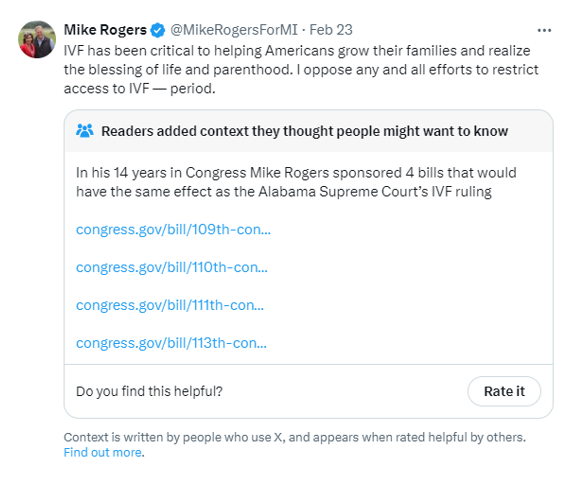
- Rogers Stated He Would Not Support Legislation In Congress That Would Interfere With Michigan Abortion Policies. According to MLive, “Rogers has previously said that he wouldn’t support policies in Congress that would upend what Michiganders had voted for in 2022.” [MLive, 2/25/24]
Rogers Lobbied For A Nationwide Abortion Ban And Repeatedly Introduced Federal Legislation That Would’ve Restricted Access To Reproductive Health Care, Including IVF Treatment
Rogers Lobbied For A Nationwide Abortion Ban And Repeatedly Introduced Federal Legislation That Would’ve Restricted Access To Reproductive Health Care, Including IVF Treatment. According to The Gander, “During his 14 years in Congress, Rogers lobbied for a nationwide abortion ban and repeatedly introduced federal legislation that would’ve restricted access to reproductive health care—including four bills that would’ve made IVF treatment illegal nationwide.” [The Gander, 2/26/24]
- Rogers Flip-Flopped On His Position Regarding In Vitro Fertilization. According to The Gander, “Former US Rep. and US Senate candidate Mike Rogers has joined ex-President Donald Trump in claiming that he supports access to in vitro fertilization (IVF) after a recent Alabama Supreme Court ruling effectively banned the treatment for families across the state.” [The Gander, 2/26/24]
Rogers Tried And Failed To Pass Similar Legislation As The IVF Ruling In Alabama At Least Four Times
Rogers Tried And Failed To Pass Similar Legislation As The IVF Ruling In Alabama At Least Four Times. According to The Gander, “But a closer look at Rogers’ voting record from his time in Congress shows that Rogers tried (and failed) on at least four separate occasions to pass federal legislation that would’ve had the exact same effect as the recent ruling in Alabama—only on a much larger, nationwide scale.” [The Gander, 2/26/24]
- Rogers Co-Sponsored The Right To Life Act. According to The Gander, “In 2005, Rogers co-sponsored a resolution called the ‘Right to Life Act’ that sought to define human life and legal personhood as beginning at ‘the moment of fertilization.’” [The Gander, 2/26/24]
- Rogers Co-Sponsored A Bill To Define Personhood As Beginning The Moment Of Conception. According to The Gander, “After that bill failed, Rogers co-sponsored another bill in 2008 that again sought to legally define personhood as beginning at the moment of conception—which would’ve provided frozen embryos with the same constitutional rights and protections as human beings.” [The Gander, 2/26/24]
- Rogers Tried To Provide Full Constitutional Protections For The “Right To Life Of Each Born And Preborn Human Person. According to The Gander, “Rogers tried again by co-sponsoring similar legislation in 2009 that sought to provide full constitutional protections for ‘the right to life of each born and preborn human person.’ Like the others, the resolution was introduced but never received a vote.” [The Gander, 2/26/24]
- Rogers Co-Sponsored Legislation Called “Life At Conception Act.” According to The Gander, “In 2013, Rogers also co-sponsored legislation called the ‘Life at Conception Act’ that, like the name implies, defined personhood as beginning ‘at the moment of fertilization.’ ‘We will see a lot of this,’ Jeff Timmer, a former executive director of the Michigan Republican Party, posted to Twitter. ‘Mike Rogers repeatedly put his name on legislation as crazy and extreme as the Alabama case that would criminalize IVF. Now he’d love to pretend otherwise.’” [The Gander, 2/26/24]
Rogers Supported Policies That Would Take Away A Woman’s Capacity To Use IVF In Pregnancy
[AUDIO] Rogers Supported Policies That Would Take Away A Woman’s Capacity To Use IVF In Pregnancy. “Senator Debbie Stabenow was asked to react to Joe Manchin saying he’s open to supporting Mike Rogers in the Michigan Senate race, ‘Well, I’m backing the Democrat in the Senate race. And I will tell you that whichever Republican it is, they are strongly running to embrace Donald Trump, who has been so bad for Michigan. And secondly, even in this latest Alabama court case on IVF, former Congressman Mike Rogers has been on the side of basically defining life in a way that would take away a woman’s capacity to be able to use IVF in pregnancy. [...]’’ [CNN This Morning, 2/27/24] 240227_SAG_5674_A
Slotkin Blasted Rogers For Co-Sponsoring Four Bills In Line With The Alabama Supreme Court’s IVF Ruling
Slotkin Blasted Rogers For Co-Sponsoring Four Bills In Line With The Alabama Supreme Court’s IVF Ruling. According to Michigan Advance, “U.S. Rep. Elissa Slotkin (D-Holly), one of the Democrats seeking the Senate seat, was also quick to connect Rogers to his voting record. ‘Come on, Mike,” she posted. “In your 14 years in Congress, you co-sponsored FOUR bills — the last one with Jim Jordan in 2013 — that would have the same effect as the Alabama Supreme Court’s IVF ruling, making it impossible for millions of couples to have a family. You don’t get to run away from your own record because you’re just now understanding the consequences.’ [Michigan Advance, 3/6/24]
- Rogers And Meijer Supported Dangerous Anti-IVF Legislation. According to Michigan Advance, “Mike Rogers and Peter Meijer support dangerous anti-IVF legislation that would rip away Michiganders’ freedom to make personal decisions. Rogers’ and Meijer’s extensive anti-choice records show that they are out-of-step with Michiganders,” said Sam Chan, Michigan Democratic Party spokesperson.” [Michigan Advance, 3/6/24]
Rogers Stated He Didn’t Believe There Should Be “Any Restrictions” On IVF
Rogers Stated He Didn’t Believe There Should Be “Any Restrictions” On IVF. According to Detroit News, “Rogers told The Detroit News that he doesn’t think there should be ‘any restrictions’ on IVF, but he did not commit to supporting legislation to protect it at the federal level, saying it should be left to state legislatures. ‘I always think health care is better as close to people who are in need of those services, so I might default position to letting the states do it,’ Rogers said. ‘I support no restrictions on it at all. I think it's a great way to bring families into the world for people who are struggling to have kids, and we ought to celebrate it.’”
- Rogers Stated: “I Will Support No Restrictions On IVF.” According to Detroit News, “Asked about how the fetal personhood bills he sponsored in Congress squared with his support for IVF, Rogers refused to discuss the legislation: ‘I'm telling you what my position is: I will support no restrictions on IVF.’ A Rogers spokesman, Chris Gustafson, later said that, if elected again, Rogers would not co-sponsor legislation like the Life At Conception Act, the Right to Life Act or similar measures that would invalidate protections for reproductive rights enshrined by Michigan's Proposal 3 ballot initiative in 2022.” [Detroit News, 3/6/24]
Rogers Stated He Was “Essentially Punted” On IVF And Personhood Bills, Wanting States To Handle These Issues
[VIDEO] Rogers Stated He Was “Essentially Punted” On IVF And Personhood Bills, Wanting States To Handle These Issues. “Off the record discusses Mike Rogers dodging questions on IVF, ‘When I caught up with Mike Rogers about this at an event last week, I asked him how you square his past, you know, support for the personhood bills. And he said, he very much essentially punted. He said I want the states to handle this. I think this is a healthcare decision the states should do. But Democrats are going to come back and say, look, you either are going to be for federal protection or this Alabama supreme court decision is going to, or one some sort of similar case, is going to make its way to the Trump supreme court. and we know how that worked out in the Dobbs decision.’” [WCML (PBS), 3/10/2024] 240310_KNT_21032_A
Rogers Refused To Commit To Supporting Legislation To Protect IVF At The Federal Level.
Rogers Refused To Commit To Supporting Legislation To Protect IVF At The Federal Level. According to Public Now, “Rogers refuses to commit to supporting legislation to protect IVF at the federal level. When ‘asked about how the fetal personhood bills he sponsored in Congress squared’ with his so-called support for IVF, ‘Rogers refused to discuss the legislation’ and ‘very much essentially punted’ the question. If Rogers had ‘lived in Michigan instead of Florida in 2022,’ he would have ‘voted against Proposal 3 to cement the right to reproductive freedom-including abortion care-into the state Constitution.’” [Public Now, 3/18/24]