Peter Meijer
Abortion, Generally
Meijer Touted His Pro-Life Stance While Campaigning
Meijer Touted His Pro-Life Platform. According to Peter Meijer for Congress, “You know to me, I’m pro-life, because at the core, you know, we need to be a society that values life. I believe in a consistent life ethic and making sure that we’re caring for the least among us—that we’re, we have a government that is compassionate, that’s doing everything it can to life people up. Um, I’m at odds with my party: I don’t support the death penalty, um, I’m not, I think all too often Republicans get criticized for you know, caring about an unborn child until it’s a born child, uh, and then taking a—a dismissive approach. You know I think we need to be making sure that we are, we are caring for the child and the mother, we are caring for families, we are not putting them at a disadvantage or penalizing folks who, you know, want to have children, want to grow their family.” [YouTube, Peter Meijer for Congress, 10/15/20]
Meijer: “I Am 100% Pro-Life And Will Defend Life From Conception To Natural Death.” According to VoteMeijer, “I am 100% pro-life and will defend Life from conception to natural death. I vehemently oppose any federal funding to support abortion.” [VoteMeijer, accessed 6/27/23]
Meijer Said He Did See The Need For Federal Legislation To Ban Or Restrict Abortion. According to the Detroit News, “If Roe falls, Meijer said he does see a need for federal legislation to ban or restrict abortion, but he expects in the short-term the conversation will focus on the state level because President Joe Biden would likely veto such a bill.” [Detroit News, 5/24/22]
Meijer Claimed The “Anti-Life Community” Treated Unborn Children As An Inconvenience. According to Peter Meijer for Congress, “But a lot of that’s not as controversial as making sure that we’re doing everything we can to protect life and to protect the unborn you know, a child is not an inconvenience—a child is not something that is holding back. I mean that is, everything in life that has value, that has meaning requires sacrifice, requires commitment. Um, whether it’s a relationship, whether it is, um, investing in your faith, or whether it is investing in that child and making sure that um, we aren’t treating the unborn, um, like so much of the anti-life community does. That we’re not treating the unborn like an inconvenience because that-that is a gift that is out future. Um, we need to have a consistent, empathetic approach.” [YouTube, Peter Meijer for Congress, 10/15/20]
Meijer Opposed Exceptions
Meijer Did Not Support Abortion In Cases Of Rape Or Incest. According to Detroit News, “Both supported the recent U.S. Supreme Court decision to overturn Roe v. Wade and do not support exceptions for abortion in cases of rape or incest.” [Detroit News, 8/2/22]
Meijer Opposed Exceptions For Rape And Incest. According to the Detroit News, “Meijer opposes exceptions for rape or incest, stressing such cases represent about 1% of abortions, but he does support exceptions for the mother's life, he said. Meijer challenger John Gibbs, who is endorsed by former President Donald Trump, opposes rape and incest exceptions, saying a child doesn't deserve to be punished for what happened.’” [Detroit News, 5/24/22]
Meijer Was Rated An A For His Support Of Pro-Life Policy
Meijer Scored An A In The Susan B. Anthony Pro-Life America Family Rating Scale. [Susan B. Anthony Pro-Life America Family, accessed 7/25/23]
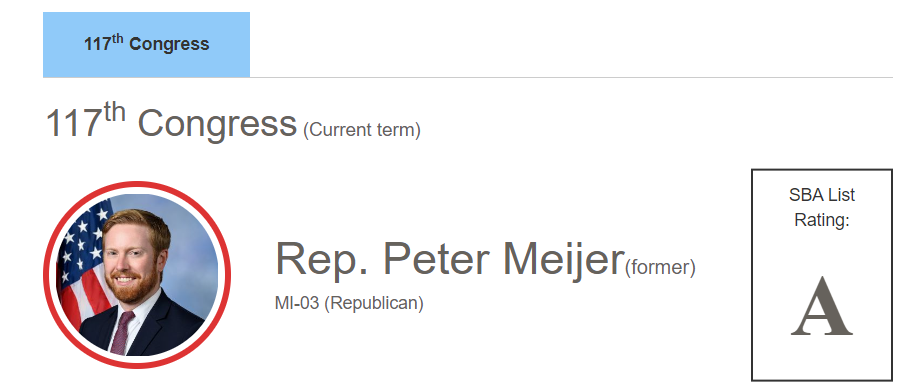
Susan B Anthony List: Meijer Led With A Pro-Life Agenda That Actively Worked Against Expanding Abortion Access And Funding. According to Susan B. Anthony Pro-Life America Family, “Congressman Meijer has stood up against the pro-abortion agenda of the Biden-Harris administration and Pelosi Democrats who are actively working to expand abortion access and abortion funding. Rep. Meijer has voted consistently to defend the lives of the unborn and infants. This includes stopping hard-earned tax dollars from paying for abortion, whether domestically or internationally, and protecting health care provider rights for those who refuse to engage in brutal abortions.” [Susan B. Anthony Pro-Life America Family, accessed 7/25/23]
Roe v. Wade
Meijer Signed The Amicus Brief To Overturn Roe V. Wade
Meijer Signed The Amicus Brief Urging The Supreme Court To Overturn Roe V. Wade. According to Thomas E. Dobbs, M.D., M.P.H., In His Official Capacity As State Health Officer Of The Mississippi Department Of Health, Et Al., Petitioners, V. Jackson Women’s Health Organization, On Behalf Of Itself And Its Patients, Et Al., “Amici are 228 Members of Congress—44 Senators and 184 Members of the House of Representatives— representing 40 states. (See Appendix for List of Amici.) […] It is long overdue for this Court to return lawmaking to legislators. ‘The most reliable objective signs [of societal views] consist of the legislation that the society has enacted. It will rarely if ever be the case that the Members of this Court will have a better sense of the evolution in views of the American people than do their elected representatives.’7 For these reasons, Amici respectfully urge the Court to affirm the constitutional authority of the federal and state governments to safeguard the lives and health of their citizens, born and not yet born. […] Peter Meijer (MI-03)” [Supreme Court of the United States, Thomas E. Dobbs, M.D., M.P.H., In His Official Capacity As State Health Officer Of The Mississippi Department Of Health, Et Al., Petitioners, V. Jackson Women’s Health Organization, On Behalf Of Itself And Its Patients, Et Al, 7/29/21]
Meijer Supported Overturning Roe
Meijer Supported The Overturn Of Roe v. Wade And Said It Was “Tremendous.” According to MLive, “Meijer, R-Grand Rapids, hailed the Supreme Court’s decision for ‘returning power back to the states, the American people and the lawmakers chosen to represent them.’ ‘I have long maintained that our nation’s laws and policies should reflect a commitment to the sanctity of human life at every stage, and this ruling is a tremendous step toward upholding this crucial moral responsibility,’ Meijer said in a prepared statement.” [MLive, 6/24/22]
Meijer Said Roe Was “Poorly Reasoned” And That Abortion Should Be Debated By Elected Representatives. According to the Detroit News, “Freshman U.S. Rep. Peter Meijer, R-Grand Rapids Township, is running for a second term in the new 3rd District, which covers the Grand Rapids, Grand Haven and Muskegon areas. Meijer supports overturning Roe, which he called ‘poorly reasoned,’ saying the issue should be debated by elected representatives. ’It's important that we have decisions at the federal Supreme Court level that hew more closely to the Constitution and don't just sort of invent unenumerated rights out of whole cloth.’” [Detroit News, 5/24/22]
Women’s Health Protection Act
Meijer Voted Against Abortion Protections
Meijer Voted Against The Women’s Health Protection Act And Said It Went “So Far And Beyond” What Was In Roe. According to the Detroit News, “Meijer voted no on the Women's Health Protection Act and criticized it as going ‘so far and beyond’ what was in Roe that not even all Senate Democrats voted for it this month (West Virginia Sen. Joe Manchin was a no).” [Detroit News, 5/24/22]
2021: Meijer Voted Against The Women's Health Protection Act Of 2021, Which Would Protect The Right To Abortion Access And Prohibit Restrictions On Abortion. In September 2021, Meijer voted against the Women's Health Protection Act of 2021 which would, according to Congressional Quarterly, “statutorily establish that health care providers have a right to provide and patients have a right to receive abortion services, and it would prohibit certain restrictions related to abortion services. The bill would specify that rights established by the bill may not be restricted by certain requirements or limitations related to abortion services, including prohibitions on abortion prior to fetal viability, or after fetal viability if a provider determines that continuation of a pregnancy would pose a risk to a patient's life or health; requirements that patients disclose reasons for seeking an abortion or make medically unnecessary in-person appointments; requirements that providers provide medically inaccurate information or perform specific medical tests or procedures in connection with the provision of abortion services; limitations on providers' ability to prescribe drugs based on good-faith medical judgment, provide services via telemedicine or provide immediate services when a delay would pose a risk to a patient's health; and requirements for facilities and personnel that would not apply to facilities providing medically comparable procedures. It would also prohibit requirements or limitations that are similar to those established by the bill or that impede access to abortion services and expressly or implicitly single out abortion services, providers or facilities.” The vote was on passage. The House passed the bill by a vote of 218-211. The Senate failed to invoke cloture on the bill in February 2022. [House Vote 295, 9/24/21; Congressional Quarterly, 9/24/21; Congressional Actions, H.R. 3755]
- The Bill Would Prohibit Abortion Restrictions And Establish That Health Care Providers Have A Right To Provide Abortions And Individuals Have The Right To Receive An Abortion. According to Congressional Quarterly, “Passage of the bill that would statutorily establish that health care providers have a right to provide and patients have a right to receive abortion services, and it would prohibit certain restrictions related to abortion services.” [Congressional Quarterly, 9/24/21]
- The Bill Would Prohibit Abortion Restrictions, Including Measures Restricting Abortions Before Fetal Viability And When The Patient’s Life Is At Risk, Measures Requiring Justification For Seeking An Abortion, And Measures Requiring Medical Personnel To Provide Inaccurate Information Or Unnecessary Medical Tests To Discourage Abortions. According to Congressional Quarterly, “The bill would specify that rights established by the bill may not be restricted by certain requirements or limitations related to abortion services, including prohibitions on abortion prior to fetal viability, or after fetal viability if a provider determines that continuation of a pregnancy would pose a risk to a patient’s life or health; requirements that patients disclose reasons for seeking an abortion or make medically unnecessary in-person appointments; requirements that providers provide medically inaccurate information or perform specific medical tests or procedures in connection with the provision of abortion services; limitations on providers’ ability to prescribe drugs based on good-faith medical judgment, provide services via telemedicine or provide immediate services when a delay would pose a risk to a patient’s health; and requirements for facilities and personnel that would not apply to facilities providing medically comparable procedures.” [Congressional Quarterly, 9/24/21]
2022: Meijer Voted Against Codifying The Right To Receive Abortion Services And The Right For Medical Providers To Provide Abortion Services And Against Prohibiting Abortion Restrictions. In July 2022, according to Congressional Quarterly, Meijer voted against the Women’s Health Protection Act of 2022, which would “statutorily establish that health care providers have a right to provide and patients have a right to receive abortion services, and it would prohibit certain restrictions related to abortion services. The bill would specify that rights established by the bill may not be restricted by certain requirements or limitations related to abortion services, including prohibitions on abortion prior to fetal viability, or after fetal viability if a provider determines that continuation of a pregnancy would pose a risk to a patient's life or health; requirements that patients disclose reasons for seeking an abortion or make medically unnecessary in-person appointments; requirements that providers provide medically inaccurate information or perform specific medical tests or procedures in connection with the provision of abortion services; limitations on providers' ability to prescribe drugs based on good-faith medical judgment, provide services via telemedicine or provide immediate services when a delay would pose a risk to a patient's health; and requirements for facilities and personnel that would not apply to facilities providing medically comparable procedures. It would also prohibit requirements or limitations that are similar to those established by the bill or that impede access to abortion services and expressly or implicitly single out abortion services, providers or facilities.” The vote was on passage. The House passed the bill by a vote 219-210, thus the bill was sent to the Senate. The Senate did not take substantive action on the bill. [House Vote 360, 7/15/22; Congressional Quarterly, 7/15/22; Congressional Actions, H.R. 8296]
- The Bill Specified The Factors That Courts Could Consider When Determining Whether A Regulation Were To Limit Or Impede Access To Abortion And Required The Party Defending The Regulation To Prove That It Advances The Safety Of Abortion Or The Patient’s Health. According to Congressional Quarterly, “It would specify factors that courts may consider to determine whether a requirement or limitation impedes access to abortion services, including whether it interferes with providers' ability to provide services; poses a risk to patients' health; is likely to delay or deter patients in accessing services or necessitate in-person visits that would not otherwise be required; is likely to result in a decreased availability of services in a state or region; is likely to result in increased costs of providing or obtaining services; or imposes penalties that are not imposed on other health care providers for comparable conduct. It would require a party defending a requirement or limitation to establish that it significantly advances the safety of abortion services or patient health and that such goals cannot be advanced by a less restrictive alternative measure.” [Congressional Quarterly, 7/15/22]
- The Bill Authorized The Justice Department, Medical Providers, And Individuals And Entities To Sue In Federal Court Against Any Governmental Entity That Were To Implement Abortion Restrictions. According to Congressional Quarterly, “It would authorize the Justice Department, health care providers and private individuals and entities to bring a civil action in U.S. district court for injunctive relief against any state or government official charged with implementing or enforcing a requirement or limitation challenged as a violation of rights established by the bill. It would authorize district courts to award appropriate equitable relief, including temporary, preliminary or permanent injunctive relief, and to award costs of litigation to a prevailing plaintiff. It would require courts to ‘liberally construe’ provisions of the bill to effectuate its purposes.” [Congressional Quarterly, 7/15/22]
Meijer Voted Against Prohibiting Individuals Acting Under State Law From Restricting An Individual’s Access To Out-Of-State Abortion Services
2022: Meijer Voted Against Prohibiting Individuals Acting Under State Law From Restricting An Individual’s Access To Out-Of-State Abortion Services And Against Prohibiting The Restriction Of Interstate Movement Against Any FDA-Approved Abortion Drug. In July 2022, according to Congressional Quarterly, Meijer voted against the Ensuring Women’s Right to Reproductive Freedom Act, which would “prohibit individuals from interfering with patients' ability to access to abortion services in another state where the services are legal. Specifically, it would prohibit any person acting under color of state law from preventing, restricting or retaliating against health care providers' ability to provide abortion services that are legal in the provider's state to patients who do not reside in that state; a person's ability to assist in providing such services; or a person's ability to travel or assist another person traveling across state lines to obtain an abortion. It would also prohibit individuals from preventing, restricting or retaliating against the interstate movement of any drug approved by the Food and Drug Administration for the termination of a pregnancy.” The vote was on passage. The House passed the bill by a vote 223-205, thus the bill was sent to the Senate. The Senate did not take substantive action on the bill. [House Vote 362, 7/15/22; Congressional Quarterly, 7/15/22; Congressional Actions, H.R. 8297]
- The Bill Would Permit The U.S. Attorney General Or A Harmed Individual To Sue In Federal Court Against An Individual Who Violates The Bill. According to Congressional Quarterly, “It would allow the U.S. attorney general or a harmed individual to bring a civil action in U.S. district court for declaratory and injunctive relief against an individual who violates the prohibitions.” [Congressional Quarterly, 7/15/22]
- The Bill Would Reaffirm The Right For An Individual Seeking Abortion Services To Travel Across State Lines Without Restrictions. According to The Washington Post, “Another bill, the Ensuring Women’s Right to Reproductive Freedom Act, would reaffirm the right for someone seeking an abortion to travel freely across state lines. The House passed that measure, 223-205, with three Republicans — Adam Kinzinger (Ill.), Fred Upton (Mich.) and Brian Fitzpatrick (Pa.) — joining all Democrats in backing the bill.” [The Washington Post, 7/15/22]
- Congresswoman Lizzie Fletcher (D) From Texas: Prohibiting Travel Restrictions For Abortion Access Was Consistent With The Constitutional Right To Interstate Travel. According to The New York Times, “Representative Lizzie Fletcher, Democrat of Texas, said her bill prohibiting states from enacting or enforcing laws restricting travel to obtain an abortion was consistent with the constitutional right to interstate travel.” [New York Times, 7/15/22]
Contraception
Meijer Voted Against The Right To Contraception Act
2022: Meijer Voted Against Codifying The Right To Access Contraceptives And The Right For Health Care Providers To Provide Contraceptives To Their Patients. In July 2022, according to Congressional Quarterly, Meijer voted against the Right to Contraception Act, which would “protect a person's ability to access contraceptives and to engage in contraception, and to protect a health care provider's ability to provide contraceptives, contraception, and information related to contraception.” The vote was on passage. The House passed the bill by a vote 228-195, thus the bill was sent to Senate. The Senate did not take substantive action on the bill. [House Vote 385, 7/21/22; Congressional Quarterly, 7/21/22; Congressional Actions, H.R. 8373]
- The Bill Was A Resulted From The U.S. Supreme Court’s Overturn Of Roe V. Wade And Concerns That The Court May Revisit Same-Sex Marriage And The Right To Contraception. According to The New York Times, “House Democratic leaders opted to move forward with the bill after the Supreme Court’s decision overturning abortion rights raised worries about the prospect that the justices might revisit cases that affirmed same-sex marriage rights and the right to contraception. The debate in Congress thrust the issue into the midterm election campaign, where Democrats are eager to draw a distinction between their party’s support for L.G.B.T.Q. rights and opposition by many Republicans.” [New York Times, 7/19/22]
- The Bill Would Establish The Federal Right For Contraception Access And The Right For Medical Providers To Provide Contraceptives. According to Reuters, “The bill would create a federal right for people to access contraceptives and for doctors and pharmacists to provide them. Contraceptives are used by 88% of U.S. women of childbearing age who are not trying to get pregnant, according to the Guttmacher Institute, an abortion rights advocacy group.” [Reuters, 7/21/22]
Washington, D.C.
Meijer Voted AGaisnt Ending Prohibition Of Local And Federal Funds For Abortion Services
2022: Meijer Voted Against Ending A Prohibition On The Use Of Local And Federal Funds For Abortion Services In D.C. In July 2022, according to Congressional Quarterly, Meijer voted against the Transportation, Housing and Urban Development, and Related Agencies Appropriations Act, 2023, which would “end a prohibition on the use of local and federal funds for abortion services in the District of Columbia.” The vote was on passage. The House passed the bill by a vote 220-207, thus the bill was sent to the Senate. The Senate did not take substantive action on the legislation. Congress passed and signed into law the FY 2023 Budget through H.R. 2617. [House Vote 383, 7/20/22; Congressional Quarterly, 7/20/22; Congressional Actions, H.R. 8294]